We independently review everything we recommend. When you buy through our links, we may earn a commission. As an Amazon Associate we earn from qualifying purchases.
Best Bike for Your Buck: 5 Value Hybrid Bikes Worth Buying
Find the best bike for your buck with five value hybrid bikes compared on frame, gears, brakes and fit — Schwinn Network 1, GTX 1, GTX 2, Discover and Wayfarer.
Find the best bike for your buck with five value hybrid bikes compared on frame, gears, brakes and fit — Schwinn Network 1, GTX 1, GTX 2, Discover and Wayfarer.
As an Amazon Associate we earn from qualifying purchases.
Affiliate Disclosure: This article contains affiliate links. If you buy through a link on this page, we may earn a commission at no extra cost to you.
The best bike for your buck is not simply the cheapest bike you can find, and it is not the bike with the longest feature list either. Value means you get a frame that fits you, gearing that covers the hills on your actual routes, brakes you can trust in traffic, and parts that a local shop can service without special orders. A bike that costs a little more but uses a standard aluminum frame, common 700c wheels, and widely available Shimano or twist-shift components will usually save you money over two or three seasons, because tires, tubes, brake pads, and cables are easy to replace.
This guide focuses on hybrid bikes, because for most riders asking about value, a hybrid is the right category. A hybrid blends the upright comfort of a city bike with the faster-rolling 700c wheels of a road bike. It works for commuting, fitness rides, paved rail trails, and light gravel paths without forcing you into a hunched racing position or a heavy mountain bike build. All five picks below are hybrids sold on Amazon US, so they are the same type of product and can be compared fairly on frame, gearing, braking, and fit.
Before you compare models, be honest about three things. First, where will you ride most often: flat city streets, rolling suburbs, or mixed pavement and dirt paths? Second, how tall are you, and do you prefer a step-over or step-through frame for getting on and off at lights? Third, will you carry anything — a work bag, groceries, or a child seat — because that decides whether a rear rack and fenders are conveniences or necessities. The picks below are ordered to help different value shoppers, not to crown one bike for everyone.
Quick comparison
Pick
Best for
Frame
Speeds
Brakes
Wheels
Schwinn Network 1
Best overall value
Aluminum
21
Linear pull
700c
Schwinn GTX 1
Pavement and light trails
Aluminum dual-sport
21
Linear pull
700c
Schwinn GTX 2
Rougher paths, stronger stopping
Aluminum dual-sport
21
Mechanical disc
700c
Schwinn Discover
Commuting with rack and fenders included
Aluminum
21
Linear pull
700c
Schwinn Wayfarer
Retro comfort and simple gearing
Steel
7
Linear pull
700c
1. Schwinn Network 1 Hybrid Bike — best overall value
Top Pick
1. Schwinn Network 1 Hybrid Bike — best overall value
The Schwinn Network 1 is the clearest answer to the value question for most riders. Its listing describes a 700c hybrid with an aluminum frame, a suspension fork, alloy linear pull brakes, and a 21-speed twist-shift drivetrain. That combination is exactly what a value hybrid should be: light enough to carry up a short flight of stairs, geared low enough for ordinary hills, and built around parts any bike shop will recognize.
The aluminum frame matters for value over time. Aluminum does not rust the way an untreated steel frame can, and it keeps the complete bike manageable for lifting onto a car rack or into an apartment. The suspension fork is not a mountain bike fork and should not be treated as one, but for broken pavement, driveway lips, and packed gravel it takes the sharp edge off impacts that a rigid fork would send straight to your wrists. For riders whose commute includes patched roads, that comfort is not a luxury — it is the difference between riding daily and leaving the bike in the garage.
The 21 speeds come from a triple chainring setup with twist shifters. Twist shifters are simple to learn: you rotate the grip to change gear, which many returning riders find less intimidating than trigger levers. The trade-off is precision. Twist shifting can feel less crisp under load, so the smart habit is to ease off the pedals slightly as you shift on a climb. Used that way, the drivetrain covers flat cruising and moderate hills without needing an upgrade on day one.
Fit is the main thing to check. The Network 1 is offered in adult frame sizes for men and women, and 700c wheels suit average to taller riders best. If you are well under average height, stand-over clearance deserves a careful check against the size chart on the product page before you order. Value disappears quickly if the frame is too large, no matter how good the component list looks.
Choose the Network 1 if you want one bike for commuting, weekend path rides, and general fitness, and you want the most balanced mix of weight, gearing, and comfort in this list. Skip it if you know you need disc brakes for steep, wet descents — that is the GTX 2 below — or if you want a rack and fenders included from the start, which is the Discover.
2. Schwinn GTX 1 Hybrid Bike — value for mixed surfaces
Runner-Up
2. Schwinn GTX 1 Hybrid Bike — value for mixed surfaces
The Schwinn GTX 1 uses an aluminum dual-sport frame, a suspension fork, 700c wheels, and a 21-speed drivetrain with front and rear linear pull brakes, according to its Amazon US listing. Dual-sport in this context means the bike is tuned for a mix of pavement and light off-pavement use: the tires and geometry are a step more versatile than a pure city hybrid, while the riding position stays upright and relaxed.
That versatility is where its value lies. Many riders buy a narrow-purpose bike and then replace it within a year when their riding changes — they join friends on a gravel rail trail, or their commute adds a dirt shortcut. The GTX 1 gives you headroom for that change without moving into a true mountain bike, which would be slower and heavier on the road sections that still make up most rides. The multi-use tires listed for the GTX line are the key detail: they roll acceptably on pavement and still grip on hard-packed paths.
The listed weight and frame size vary by variant, so confirm the exact size on the product page. The GTX 1 has commonly been listed with a larger adult frame, which suits taller riders well but can be too much bike for shorter riders. As with the Network 1, the 21-speed gearing is a practical range for rolling terrain, and the linear pull brakes are inexpensive to maintain — pads and cables are cheap, standard parts.
There are honest limits. Linear pull brakes do not match disc brakes for stopping power in sustained rain, and a dual-sport hybrid is still not a trail bike: roots, rocks, and mud will overwhelm its fork and tires quickly. Within its intended mix of roads, bike lanes, and maintained paths, though, the GTX 1 is a strong value because it delays or removes the need for a second bike.
Choose the GTX 1 if your routes mix pavement with light trails and you are an average-height to tall rider. Choose the GTX 2 instead if those paths are rougher or your area is hilly and wet enough that disc brakes are worth prioritizing.
3. Schwinn GTX 2 Hybrid Bike — value with disc brakes
3. Schwinn GTX 2 Hybrid Bike — value with disc brakes
The Schwinn GTX 2 keeps the dual-sport idea of the GTX 1 — aluminum frame, suspension fork, 700c wheels, 21 speeds — and upgrades the braking to mechanical disc brakes, per its Amazon US listing. It has also been listed with trigger-style shifting in GTX 2 trim. Those two changes make it the value pick for riders who ride in rain, carry loads downhill, or simply want braking that feels consistent from the first stop to the last.
Mechanical disc brakes are a sensible middle ground for a value bike. They offer better wet-weather performance and more even pad wear than rim brakes, yet they are still cable-operated, so adjustment uses familiar tools and does not require hydraulic bleeding. Pads cost more than rim brake pads, but they also tend to last well and do not wear down your wheel rims, which protects the value of the wheels themselves over years of use.
The GTX 2 listing describes an 18-inch frame variant weighing just under 34 pounds. That is not light in absolute terms, but it is reasonable for a suspension-fork dual-sport bike, and the weight is a fair trade for the fork and disc brakes at this level. Riders who must carry a bike up several flights of stairs every day should weigh that trade carefully — for them, the simpler Network 1 may be the better value despite its rim brakes.
Gearing remains a 21-speed Shimano-based setup in the listing, with EZ-Fire style trigger shifters noted for this model line. Trigger shifters give a more positive click per shift than twist shifters and are preferred by many riders who shift often in rolling terrain. If you ride mostly flat ground, that difference is minor; if your commute is a series of short climbs, it is a real quality-of-life gain.
Choose the GTX 2 if you want the strongest stopping and the most trail headroom in this list and your budget stretches to it. It is the pick that best protects its value in wet, hilly places. If you ride only dry, flat pavement, its advantages narrow and the Network 1 or Wayfarer will serve you just as well.
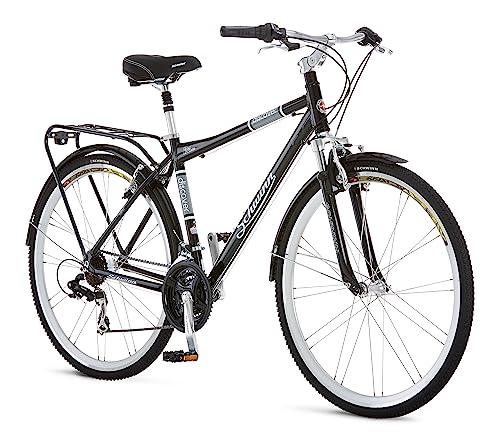
4. Schwinn Discover Hybrid Bike — value with commuting kit included
4. Schwinn Discover Hybrid Bike — value with commuting kit included
The Schwinn Discover has been sold on Amazon US for many years, and its value case is completeness. The listing describes a 21-speed hybrid with 700c wheels, a choice of step-through or step-over aluminum frames, front and rear fenders, and a rear cargo rack included. Bought separately, a rack and full fenders add meaningful cost and fitting time to any other bike in this list. On the Discover, they are part of the package and designed for the frame.
That matters most for commuters. Fenders keep road spray off your clothes and shoes, which is often the difference between riding to work and driving on a damp morning. A rear rack lets you carry a pannier or a strapped-down bag instead of a sweaty backpack, and it opens up grocery runs that turn a bike from a leisure item into genuine transport. A bike that replaces car trips earns its cost back in a way a purely recreational bike does not, and the Discover is set up for exactly that from the first ride.
The step-through option deserves attention for value shoppers who share a bike or who have limited flexibility. A low step-over height makes mounting easier with a loaded rack, when swinging a leg high over bags is awkward. The Discover line has been listed in smaller frame sizes as well, which helps shorter riders who find 700c hybrids with tall step-over frames intimidating.
The trade-offs are weight and sportiness. Fenders, a rack, and a comfort-oriented build make the Discover a practical tool rather than a brisk fitness bike, and its linear pull brakes are adequate rather than outstanding. Assembly and a post-assembly tune also matter: a long-running model like this rewards a careful setup check of brakes, shifting, and wheel trueness before regular use, ideally by a local shop if you are not confident doing it yourself.
Choose the Discover if commuting, errands, and all-weather practicality are your main jobs for the bike. It is arguably the best bike for your buck in this list if you count the accessories you would otherwise buy within the first month.
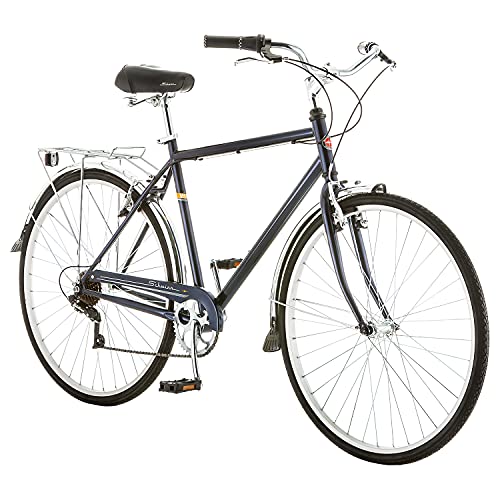
5. Schwinn Wayfarer Hybrid Bike — simple, retro value
5. Schwinn Wayfarer Hybrid Bike — simple, retro value
The Schwinn Wayfarer takes the opposite approach to value: fewer parts, done simply. Its listing describes a steel retro-style frame, a 7-speed drivetrain with a twist shifter, linear pull brakes, 700c wheels, a rear rack, and fenders on many variants. Seven speeds sound limited next to the 21-speed bikes above, but for flat to gently rolling city riding they cover the gears most riders actually use, with less to adjust and less to go wrong.
The steel frame is central to the Wayfarer experience. Steel is heavier than aluminum, but it gives a naturally forgiving ride feel and the retro frame design pairs it with an upright position, a comfortable saddle position, and swept styling that many riders simply enjoy looking at. Enjoyment is a legitimate part of value: a bike you like is a bike you ride, and cost per ride is the value metric that counts in the end.
The included rear rack and fenders repeat the Discover’s practical advantage, and the simpler drivetrain reduces long-term maintenance. A single chainring means no front derailleur to tune, and gear changes are one lever, one decision. For a rider returning to cycling after years away, or buying a bike for short trips around a neighborhood, campus, or small town, that simplicity removes friction from every ride.
The limits are clear and should be accepted before buying. Seven gears run out on steep hills, the steel frame adds weight for carrying and climbing, and the comfort geometry is not built for speed. If your routes are flat and your trips are short to moderate, none of that matters much. If you have a long, hilly commute, pick the Network 1 or GTX 2 instead and do not try to make the Wayfarer something it is not.
Choose the Wayfarer if you value comfort, style, and simplicity over range and speed, and your riding is mostly flat. In the right setting it may be the best value here precisely because it does not charge you for capability you will never use.
How to judge value before you buy any bike
Start with fit, because no discount fixes a wrong size. Use the frame size chart on the product page, compare it with your inseam and height, and prefer a size you can stand over comfortably. A slightly conservative size you can adjust with the seatpost and stem is a safer value buy than an oversized frame on sale.
Next, look at the parts that wear out. Tires, tubes, brake pads, chains, and cables are the real running costs of a value bike. All five picks use common 700c wheels and widely available drivetrain parts, which keeps those costs low and lets any shop help you. Be wary of any bargain bike with unusual wheel sizes or proprietary parts; the purchase saving can vanish at the first repair.
Then consider assembly honestly. Bikes sold online arrive partially assembled, and safe riding depends on correct tightening of the stem, handlebar, pedals, and brakes, plus true wheels and adjusted shifting. If you are not confident, budget for a shop assembly or safety check as part of the true cost. A properly set up value bike rides better and lasts longer than a more expensive bike assembled carelessly, so this step protects your money rather than adding to it.
Finally, think in cost per ride. A bike ridden three times a week for commuting and errands repays its cost quickly in saved fuel, parking, and transit fares, even before fitness benefits. That is why the best bike for your buck is the one matched to your real routes: the Discover for loaded commuting, the GTX 2 for wet and hilly mixed routes, the Network 1 as the all-round balance, the GTX 1 for light trail variety, and the Wayfarer for flat, relaxed riding.
Care tips that protect a value bike
Value is also about lifespan. Keep tires inflated to the pressure range printed on the sidewall; underinflated tires feel slow, wear quickly, and pinch-flake tubes on potholes. Wipe and lightly lubricate the chain regularly, especially after wet rides, because a worn chain accelerates wear on the more expensive cassette and chainrings. Check brake pads before they wear to the backing material, and learn to adjust cable tension as pads wear — this is simple on both linear pull and mechanical disc brakes.
Store the bike dry when you can. The aluminum-framed picks resist frame rust, but chains, cables, and steel hardware on any bike corrode with constant outdoor storage. A basic floor pump, a spare tube in your size, tire levers, and a mini multi-tool cover most roadside problems and cost little compared with a single rescue ride home.
Verdict
For most people, the Schwinn Network 1 is the best bike for your buck: a balanced aluminum hybrid with useful gearing and comfort features that fit commuting, fitness, and path riding in one purchase. If you need the bike to earn its keep as transport, the Schwinn Discover adds the rack and fenders that make daily utility riding realistic. Riders on rougher or wetter routes should step up to the GTX 2 for disc brakes, with the GTX 1 as the lighter-duty mixed-surface option, and flat-route comfort seekers will get the most smiles per ride from the simple Wayfarer. Match the bike to your routes and your size, set it up carefully, and any of these five will deliver strong value for years.
M
Melu Editorial Team
We compare specs, materials and verified owner reviews before a product earns a spot. Rankings are never paid.
Affiliate disclosure. As an Amazon Associate we earn from qualifying purchases at no extra cost to you. Prices accurate as of the date shown.
Find the right replacement battery for the HTC Inspire 4G by part number BD26100: correct voltage, capacity, fit checks, wrong-code warnings and safe buying steps.
Find the best motor bike in India by segment: commuter, premium commuter, cruiser, sport and adventure models, plus the criteria that matter before you visit a dealer.
Explore the best bike trails in San Antonio: the Howard W. Peak Greenway, Mission Trail, River Walk, Leon Creek and Salado Creek, with difficulty, surface and safety notes.
The best Bay Area bike trails by region and rider: paved bayshore paths, car-free park roads, canal and creek trails, and shaded redwood routes, with difficulty and planning notes.
Compare five doorbell cameras for wired and battery homes, covering video clarity, motion alerts, storage, chimes and ongoing costs for your front door.
Find the best cheesecake singapore serves, from molten Basque burnt cakes and light Japanese souffle to rich New York slices, with tips for every craving.

 1. Schwinn Network 1 Hybrid Bike — best overall value
 2. Schwinn GTX 1 Hybrid Bike — value for mixed surfaces
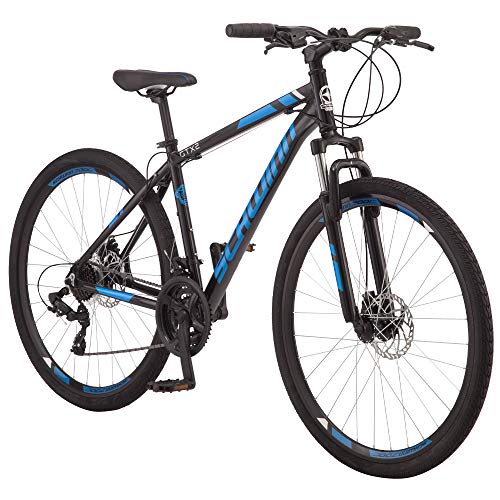 3. Schwinn GTX 2 Hybrid Bike — value with disc brakes
 4. Schwinn Discover Hybrid Bike — value with commuting kit included
 5. Schwinn Wayfarer Hybrid Bike — simple, retro value