We independently review everything we recommend. When you buy through our links, we may earn a commission. As an Amazon Associate we earn from qualifying purchases.
4 Best Practice Arrows for Recurve Bows (November 2026)
Compare four carbon practice arrow sets for recurve bows by spine, length, fletching and points, with fit notes for club, backyard and field shooting.
Compare four carbon practice arrow sets for recurve bows by spine, length, fletching and points, with fit notes for club, backyard and field shooting.
Buying practice arrows for a recurve bow looks simple until the first set arrives and flies sideways. The real decision is not the brand on the box; it is whether the spine, length and point weight suit the bow in your hand, because a recurve with no sight and no release aid shows every mismatch in arrow flex. A set that is too stiff kicks left, one that is too soft wanders right, and both teach your hands the wrong lesson while you blame your form.
This roundup is for new recurve owners building a first dozen, club shooters who burn through arrows at weekly sessions, and traditional archers who want feather fletching that clears a shelf rest cleanly. Every set below is a carbon practice arrow sold as a complete pack, and each one was picked from its Amazon listing title and printed specifications: shaft length, spine options, fletching type, point style and pack count are the fields that decide whether a set belongs here.
Quick Picks
As an Amazon Associate we earn from qualifying purchases
Product
Best for
Key spec from title
Pinals Traditional Archery Carbon Feather Arrows, 12 pack
Traditional shooters who want a chosen spine
Spine 400 in a 30 inch shaft, 4 inch turkey feathers
LWANO 30 Inch Feather Carbon Arrows, 12 pack
Lighter club bows shot off the shelf
Spine 500, 5 inch turkey feathers, 30 inch shaft
TOPARCHERY Premium 30 Inch Carbon Arrows, 12 pack
One fixed practice setup, bamboo look
Spine 500, 4 inch turkey feathers, bamboo pattern
TIGER ARCHERY 30 Inch Carbon Arrows, 12 pack
Stronger bows and high weekly volume
Listed for 35 to 60 lb bows, removable tips
How to Choose
Spine matched to your bow weight
Spine describes how much a shaft bends under a set load, and recurve bows punish a poor match because the arrow must flex around the riser on release. Read your bow weight at your own draw length, then pick the spine the maker charts for that weight: a 30 pound bow usually pairs with a soft 600 or 700 spine, a 40 pound bow with 500, and a 50 pound bow with 400. When a listing sells several spines under one page, the variant you choose at checkout is the product you get, so confirm the spine in the option name before ordering.
Length with a safety margin
An arrow should reach past the riser at full draw with room to spare, because a shaft that pulls back onto the rest or the shelf can slip and cause a dangerous shot. Measure your draw length, then add at least an inch: a 28 inch draw points to a 30 inch arrow, which is why most packs in this roundup sit at that length. Longer shafts also soften the effective spine a touch, so a shooter between two spine options often takes the longer, softer combination for a calmer flight off a recurve.
Feathers or vanes for your rest style
Feathers forgive contact. A recurve shot off the shelf or off a simple stick-on rest drags the fletching across the bow, and real feathers fold flat as they pass, then spring back in flight. Plastic vanes are tougher and shrug off rain, but they can kick the back of the arrow sideways when they strike a shelf, which is why vane sets suit elevated rests better. Three of the sets below carry turkey feathers for shelf shooting, while the vane-fletched set is the pick for bows fitted with a raised rest.
Points, nocks and pack count
Practice arrows earn their keep through small fittings. Screw-in points let you swap a bent point in seconds and change point weight to fine-tune flight, while glued points end a shaft’s day when they bend. Nocks that are not glued can be turned to align with your fletching and replaced after a strike from another arrow. Pack size matters as well: a dozen gives you matched ends of six for scoring plus spares for the misses that hit wood, concrete or a target leg during your first months.
This is the set for a traditional shooter who already knows the spine the bow wants and would rather choose it than accept a single fixed option. The listing family spans spine 300 through 700 across 30, 31 and 32 inch shafts, and the variant tied to this pick is the 400 spine at 30 inches, a common match for recurve bows in the mid to upper draw weights. Four inch turkey feathers in a right wing cut suit shelf shooting, and the box adds spare inserts so a shaft can be cut down later.
LWANO 30 Inch Feather Carbon Arrows, Spine 500, 12 Pack
Runner-Up
LWANO 30 Inch Feather Carbon Arrows, Spine 500, 12 Pack
Best for: beginners and club shooters with 30 to 50 pound recurve bows shot off the shelf.
Club archers with lighter bows get the friendliest match here. The spine 500 shaft at 30 inches pairs well with recurve bows in the 30 to 50 pound band that fills most club racks, and the long 5 inch turkey feathers settle the arrow quickly on short indoor lines where a bare shaft wobble has no distance to smooth out. At about 33 grams per finished arrow the set keeps a calm, forgiving flight for form work, and the screw-in tips mean a bent point costs a minute rather than an arrow.
TOPARCHERY Premium 30 Inch Carbon Arrows, Bamboo Pattern, 12 Pack
TOPARCHERY Premium 30 Inch Carbon Arrows, Bamboo Pattern, 12 Pack
Best for: traditional-look fans who want a single ready setup for a mid-weight recurve.
Brand and model: TOPARCHERY, model 02TJ34BB
Shaft material: carbon, with feather and stainless fittings
Some shooters want one decision made for them, and this set makes it: a 500 spine, 30 inch carbon shaft with 4 inch real turkey feathers and screw-in points, finished in a bamboo pattern that gives a traditional look without a wooden shaft’s warping worries. The feathers clear a shelf or a simple rest, the points carry a rubber ring that helps them stay seated, and the nocks sit unglued so you can index them to your bow. It suits a mid-weight recurve used for backyard targets and club nights alike.
TIGER ARCHERY 30 Inch Carbon Arrows, Pink White, 12 Pack
TIGER ARCHERY 30 Inch Carbon Arrows, Pink White, 12 Pack
Best for: shooters with 35 to 60 pound bows, an elevated rest, and a high weekly arrow count.
Brand and model: TIGER ARCHERY, model Predators-78
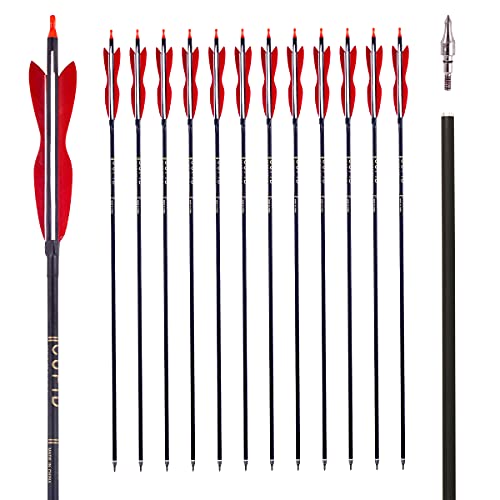
Heavier bows eat soft arrows, and this set is built for the upper band: the listing rates it for draw weights from 35 to 60 pounds, which covers the strong recurves that a 500 spine set can leave under-spined. The carbon shafts carry plastic vanes rather than feathers, so they pair best with an elevated rest, and the bright pink and white fletching is easy to follow in flight and to find in grass after a miss. Six spare nocks ride in the box alongside the dozen arrows.
Which One Fits Your Situation
A first recurve under 40 pounds
Begin with the LWANO set. Its 500 spine at 30 inches sits close to what most 30 to 40 pound bows chart, the long feathers steady a new shooter’s loose releases, and a full dozen lets you lose one to the grass without ending the session. Grow into a stiffer or softer spine later, once your draw length and form settle and your groups tell you what the bow is asking for.
Traditional bow shot off the shelf
Take the Pinals set and choose the spine your bow charts. Feathers that fold through the shelf contact keep the arrow calm where vanes would kick it wide, and the right wing cut in a 4 inch length gives a clean traditional profile. The spare inserts also help if you later trim shafts for a shorter draw or hand the set down to a smaller bow.
Strong bow, raised rest, lots of ends
The TIGER ARCHERY set fits a 45 to 60 pound bow fitted with an elevated rest. Its listed range covers the weight, the vanes stay consistent end after end, and the spare nocks keep a damaged arrow in rotation. Archers who shoot field rounds outdoors will also like how the bright fletching shows up against grass and soil when an arrow slides under the target.
Backyard targets on a mid-weight bow
The TOPARCHERY set keeps the choice simple for a 35 to 50 pound bow used at home. One spine, one length, feathers that tolerate a plain shelf, and points that unscrew when one bends on a fence post or a target frame. The bamboo finish suits a traditional bow’s look, and a dozen arrows cover a relaxed evening session with a friend sharing the bow.
Common Mistakes
Ordering the spine in the headline photo instead of the variant in the option menu, then blaming the bow for wild groups.
Shooting vanes off a bare shelf; the contact kicks the tail sideways and no amount of form work fixes a fletching clash.
Cutting shafts to draw length with no margin, leaving a point that can drop onto the hand at full draw.
Mixing two arrow sets in one quiver; small weight and spine gaps between sets open groups that look like shooter error.
Pulling arrows from a target by the shaft near the point, which bends points and loosens inserts over time.
Frequently Asked Questions
Which spine suits a 40 pound recurve?
Most makers chart a 500 spine for a 40 pound recurve at a 28 inch draw with a 100 grain point, and the 30 inch sets above in 500 spine land close to that advice. Longer draws and heavier points soften flight further. If your groups land consistently on one side with clean form, a spine change is the usual next step.
Can these arrows be shot from a compound bow too?
The listings name compound bows alongside recurve and longbow use, and the shafts themselves do not care which bow launches them. The fit rules still apply: spine must match the bow weight, and feather sets shot through a compound need a rest that gives the feathers room to pass. For a recurve-first buyer, that shared fit is a bonus rather than a reason to buy.
How many practice arrows does a beginner need?
A dozen is the practical unit. Six arrows make a standard scoring end, and the second six cover breakage, losses and the arrow that always seems to find the target frame. Beginners bend points and crack nocks often while learning to pull arrows correctly, so spares keep practice moving. Buying two matched sixes from different listings rarely matches as well as one dozen from a single set.
When should a practice arrow be retired?
Retire a shaft when you find cracks, splinters or a soft spot along its length; flex it gently and listen for crackling before each session. A bent point or a cracked nock is a fitting swap, not a retirement. Carbon that has struck concrete or a metal frame deserves a close look even when damage hides under the fletching, because a failed shaft at release can injure the bow hand.
M
Melu Editorial Team
We compare specs, materials and verified owner reviews before a product earns a spot. Rankings are never paid.
Affiliate disclosure. As an Amazon Associate we earn from qualifying purchases at no extra cost to you. Prices accurate as of the date shown.
Best heavy duty trailer rims: five 15-inch wheels compared by load capacity, bolt pattern and center bore, so your trailer rolls on rims built for the load.
Best bolt on exhaust pipe kits for a no-weld exhaust build: stainless and mild steel pipe kits in 2.5 and 3 inch sizes, compared by material and gauge.
Best boat wax for saltwater 2: five waxes and polishes compared for fiberglass and gelcoat, UV defense and salt spray, so your hull stays bright all season.
Compare the best Diamond compound bows, from the wide-range Infinite 305 to the carbon Deploy SB, with draw ranges, speeds and package contents per fit.
Four hunting bow sights compared on the listing facts that decide a season: pin count and size, micro adjustment, second-axis leveling and pin brightness.
Three CPAP cleaners for home sanitization compared: a five-minute UV-C chamber and two ultrasonic tanks, with cycle times, tank sizes, and hose fit notes.



 TIGER ARCHERY 30 Inch Carbon Arrows, Pink White, 12 Pack