We independently review everything we recommend. When you buy through our links, we may earn a commission. As an Amazon Associate we earn from qualifying purchases.
Best Boat Wax for Saltwater 2: Five Marine Waxes for Fiberglass and Gelcoat
Best boat wax for saltwater 2: five waxes and polishes compared for fiberglass and gelcoat, UV defense and salt spray, so your hull stays bright all season.
Best boat wax for saltwater 2: five waxes and polishes compared for fiberglass and gelcoat, UV defense and salt spray, so your hull stays bright all season.
Disclosure: As an Amazon Associate, this site may earn from qualifying purchases made through links on this page.
Saltwater is hard on a hull. Sun bakes the gelcoat, salt spray dries into a crust, and a season of spray and sun turns a bright hull chalky if nothing protects it. A marine wax is the layer that stands between the gelcoat and that abuse: it seals the surface, sheds water, blocks ultraviolet light, and keeps salt and grime from biting into the finish.
Not every wax suits saltwater. A wax built for a garage-kept car faces a different life than a wax on a boat that lives on a mooring. The five products in this roundup are all marine waxes and polishes made for fiberglass and gelcoat, and each one names ultraviolet and salt defense in its listing. The pool mixes liquids, a liquid gel, and a paste, because the form changes how the wax goes on and how long the job takes on a big hull.
This is the second roundup in this series, with a fresh pool of five products. Each listing below was re-opened on Amazon US and confirmed in stock at the time of writing, with the buy box live and the title matching the wax described.
At a Glance
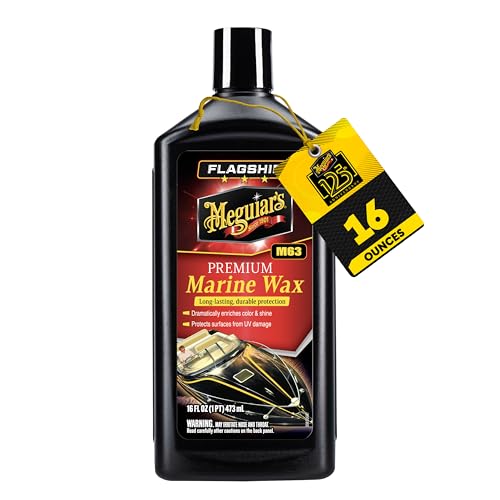
Meguiar’s M63 Flagship Premium Marine Wax, 16 oz — liquid synthetic-polymer wax for fiberglass and gelcoat, with ultraviolet protection.
Collinite 925, 16 oz — liquid-gel carnauba and polymer wax, listed at four to seven months of protection, friendly to a dual-action polisher.
Star brite Premium Marine Polish with PTEF, 16 oz — polymer polish that leaves a slick, no-stick coating, built for zero to light oxidation.
3M Perfect-It Boat Wax 36113, 1 quart — carnauba wax from the 3M Perfect-It line, the largest container in this roundup.
Collinite 885 Fleetwax, 12 oz — heavy-duty paste wax, carnauba and polymer, built for long protection on fiberglass and gelcoat.
How to Choose
Know whether you need a wax or a polish. A wax lays down a protective layer on a clean surface. A polish cleans lightly and protects in the same step, and it suits a surface with zero to light oxidation. If the hull is heavily chalked, neither is the right first step: a cleaner wax or a rubbing compound comes first, and the protection wax goes on after the surface is smooth again. Star brite is clear about this in its own guidance, and the same logic holds for every product here.
Match the form to the hull. A paste wax goes on thick and buffs off with effort, and it suits a buyer who wants the longest protection and does not mind the work. A liquid wax spreads fast and suits a big hull. A liquid gel splits the difference: it spreads like a liquid and clings like a paste. On a twenty-foot boat, the form decides whether the job takes an hour or an afternoon.
Read the chemistry, not just the shine. Carnauba wax gives a warm, deep gloss. Synthetic polymers give durability and a harder shell against ultraviolet light and salt. Most marine waxes mix the two. The mix matters less than the stated defense: look for ultraviolet protection and salt resistance named in the listing, because those are the two forces that age a saltwater hull.
Check the oxidation level before you buy. A protection wax cannot fix chalk. Run a hand over the hull: if it comes away white and powdery, the gelcoat is oxidized and needs a cleaner wax or a compound first. If the surface feels smooth and the color looks even, a protection wax is the right buy.
Think about how you apply it. Hand application works for any wax here. A dual-action polisher speeds the job on a large hull and spreads a liquid gel evenly, and Collinite 925 names dual-action use in its listing. A paste wax can go on by hand or by machine, but it takes more effort to buff off than a liquid.
Count the coverage. A sixteen-ounce bottle covers a small to mid-size boat, and the listings state how far one container goes. A quart covers more, and a paste covers multiple applications from a small container because it goes on thin. Match the container to the hull size, and remember the topsides and the deck take wax too.
The Picks
1. Meguiar’s M63 Flagship Premium Marine Wax, 16 oz
Top Pick
1. Meguiar’s M63 Flagship Premium Marine Wax, 16 oz
Meguiar’s Flagship Premium Marine Wax is the synthetic-polymer liquid in this roundup, in a sixteen-ounce bottle. The listing describes a synthetic protection formula designed for recreational vehicles and boats with durable fiberglass and gelcoat, and it adds gloss while protecting the surface. The Flagship line is Meguiar’s marine flagship, and the M63 is its liquid wax.
The listing names ultraviolet protection as part of the formula, which is the first thing to look for in a saltwater wax. The liquid form spreads fast by hand, so it suits a buyer who waxes a mid-size hull in a single session and wants the job done without a machine. Sixteen ounces is the standard bottle size for this wax, and the line also comes in a thirty-two-ounce bottle and a gallon under separate listings.
One caution: the proxy copy of this listing did not render its feature bullets, so the facts here come from the listing title, the maker line, and the Meguiar’s marine catalog, which names the M63 as the Flagship liquid wax for fiberglass and gelcoat. The wax itself is a known quantity in the marine world, but the listing gives a buyer less to check than the Collinite listings do. Confirm the size on the listing before ordering: this pick is the sixteen-ounce bottle, part number M6316.
Collinite 925 is the liquid-gel pick, and it carries the longest stated protection window in this roundup. The listing states four to seven months of high-gloss shine and durable ultraviolet protection, with marine-grade polymers that resist surface heat and salt or mineral deposits. The formula mixes carnauba wax with polymers, and the listing states it prevents oxidation, fading, and discoloration on fiberglass and gelcoat.
The listing also states that one sixteen-ounce bottle covers up to five twenty-foot fiberglass boats, which shows how thin the liquid gel spreads. It is friendly to a dual-action polisher, so a buyer with a machine can cover a large hull in sections without the arm work a paste demands. Collinite describes 925 as a liquid-gel version of its 885 Fleetwax, with a smooth spread and machine-friendly application that covers larger sections than a traditional paste.
One conflict to note: the listing bullets state four to seven months of protection, while the Collinite product description text on the same listing states four to six months. The article uses the four-to-seven figure from the bullets and flags the mismatch here, so a buyer should treat the window as an estimate from the maker rather than a promise. Either way, it is the longest stated window in this roundup.
Star brite Premium Marine Polish with PTEF is the polymer polish in this roundup, in a sixteen-ounce bottle, maker part number 85716. The listing title spells the polymer as PTFE, while the maker calls it PTEF, and the article uses the maker spelling. The polish leaves a slick, no-stick PTEF coating that reduces drag and repels dirt, grime, oil, and stains, and its ultraviolet inhibitors help stop fading and oxidation. It goes on by hand or with a buffer, and the maker states it can be applied in full sunlight.
The maker grades this polish for zero to light oxidation. That is an important limit: on a heavily chalked hull, this polish will not cut through the chalk, and a cleaner wax or a compound must come first. On a sound hull, it is a protection polish that seals the gelcoat and keeps the surface slick, which helps a saltwater hull shed spray and grime between washes.
One catalog error to note: the listing detail field lists the item form as an aerosol. That is wrong. The product is a liquid polish in a bottle, and the article does not call it an aerosol anywhere. Confirm the bottle size on the listing before ordering: this pick is the sixteen-ounce bottle.
3M Perfect-It Boat Wax is the largest container in this roundup: one quart, thirty-two fluid ounces, part number 36113. The listing states it contains carnauba wax, and it comes from the 3M Perfect-It line, the same line that makes the gelcoat compounds and polishes used in boatyards. A quart suits a buyer with a large hull, or a buyer who waxes more than one boat and wants one container to cover the season.
One substitution to note: the 3M Marine Ultra Performance Paste Wax, part number 09030, is a well-known 3M marine paste, but it did not appear in Amazon US search results, and no live listing could be confirmed for it. The Perfect-It Boat Wax is the 3M boat wax with a live listing found in this session, so it takes the 3M slot here. If the Ultra Performance Paste Wax returns to Amazon US, it is a paste-wax alternative worth a second look.
The proxy copy of this listing did not render its feature bullets, so the facts here come from the listing title, the part number, and the 3M Perfect-It line. The quart size and the carnauba content are the two firm facts on the listing. Confirm the size on the listing before ordering: this pick is the one-quart bottle.
Collinite 885 Fleetwax is the paste pick, and it is the heavy-duty member of the Collinite pair in this roundup. The listing states a carnauba-based formula with marine-grade polymers, built to protect fiberglass and gelcoat from ultraviolet exposure, surface heat, and salt or mineral deposits. It leaves a high-gloss finish with water beading, and the listing states it helps reduce oxidation, fading, and weathering.
The paste form is the point. A paste goes on thick and buffs off with moderate effort, and the listing states one twelve-ounce container covers multiple applications on fiberglass boats, depending on size and condition. That makes the small container go further than its size suggests. Collinite describes 925 as the liquid-gel version of 885, so a buyer who likes the 885 chemistry but wants a faster application can look at the 925 pick above, while a buyer who wants the hardest paste finish stays with 885.
The listing states the wax is easy to apply and buffs off with moderate effort. On a large hull, that effort adds up, and a dual-action polisher helps. On a small boat, the paste is a one-afternoon job by hand. Either way, the paste is the longest-lasting form in this roundup by construction, even though the listing does not state a month figure the way the 925 listing does.
You want the longest stated protection and a machine-friendly wax: Collinite 925. The four-to-seven-month window and the dual-action use make it the pick for a buyer who waxes once and wants the season covered.
You want the hardest paste finish and do not mind the arm work: Collinite 885 Fleetwax. The paste form and the marine-grade polymers suit a buyer who waxes a small boat by hand and wants the toughest coat.
You want a fast liquid wax for fiberglass and gelcoat: Meguiar’s M63 Flagship. The liquid form spreads fast, and the synthetic-polymer formula is built for marine use.
You want a slick, no-stick coat on a hull that is already sound: Star brite Premium Marine Polish with PTEF. Remember the limit: zero to light oxidation only. Chalked gelcoat needs a cleaner wax or a compound first.
You have a large hull or more than one boat: 3M Perfect-It Boat Wax, one quart. The container covers the most surface in this roundup, and the carnauba formula comes from a boatyard line.
Your hull is chalked and powdery: stop. None of these five is the first step. Use a cleaner wax or a rubbing compound to bring the gelcoat back, then protect it with one of the waxes above.
FAQ
What is the difference between a boat wax and a boat polish?
A wax lays down a protective layer on a clean surface. A polish cleans lightly and protects in the same step, and it suits a surface with zero to light oxidation. The Star brite pick here is a protection polish, while the other four are waxes. On a sound hull, either works. On a chalked hull, neither is the first step.
How often should a saltwater boat be waxed?
It depends on the wax and on how the boat lives. A boat on a mooring in full sun needs wax more often than a boat under cover. The Collinite 925 listing states four to seven months of protection, which is the longest window named in this roundup. As a habit, wax when the season begins and again before winter storage, and wax sooner if water stops beading on the hull.
Can wax fix oxidation?
No. Wax protects a sound surface. Oxidation is a chalky, powdery layer on the gelcoat, and it needs a cleaner wax or a rubbing compound to remove it. After the surface is smooth and the color looks even again, a protection wax keeps it that way. Waxing over heavy chalk seals the chalk in and wastes the wax.
Is paste wax better than liquid wax?
Paste wax goes on thick and tends to last longer, but it takes more effort to buff off. Liquid wax spreads fast and suits a big hull. Liquid gel splits the difference. The best form is the one you will actually use on the whole hull, because a half-waxed hull is worse than a fully waxed one with a shorter-lived wax.
Can car wax be used on a boat?
A marine wax is built for gelcoat and for salt exposure, and its listing names ultraviolet and salt defense. A car wax is built for clear-coat paint on a car. The two surfaces and the two environments differ, so a marine wax is the right buy for a hull. Use the product the listing describes for the surface you have.
Why is there no 3M Ultra Performance Paste Wax in this roundup?
The 3M Marine Ultra Performance Paste Wax, part number 09030, did not appear in Amazon US search results, and no live listing could be confirmed for it. The 3M Perfect-It Boat Wax takes the 3M slot here. If the paste wax returns to Amazon US, it is a paste alternative worth a second look.
Final Take
Five marine waxes and polishes, five ways to protect a saltwater hull. Collinite 925 brings the longest stated protection window and a machine-friendly liquid gel. Collinite 885 Fleetwax brings the hardest paste finish. Meguiar’s M63 Flagship brings a fast synthetic-polymer liquid. Star brite Premium Marine Polish brings a slick PTEF coat for a sound hull. 3M Perfect-It Boat Wax brings the largest container for a big hull.
Check the oxidation level first, then match the form to the hull size and to how you like to work. A protection wax cannot fix chalk, but on a sound hull it is the layer that keeps sun and salt from aging the gelcoat. Wax when the season begins, watch for water beading, and wax again when the beading fades.
M
Melu Editorial Team
We compare specs, materials and verified owner reviews before a product earns a spot. Rankings are never paid.
Affiliate disclosure. As an Amazon Associate we earn from qualifying purchases at no extra cost to you. Prices accurate as of the date shown.
Best heavy duty trailer rims: five 15-inch wheels compared by load capacity, bolt pattern and center bore, so your trailer rolls on rims built for the load.
Best bolt on exhaust pipe kits for a no-weld exhaust build: stainless and mild steel pipe kits in 2.5 and 3 inch sizes, compared by material and gauge.
Compare the best Diamond compound bows, from the wide-range Infinite 305 to the carbon Deploy SB, with draw ranges, speeds and package contents per fit.
Four hunting bow sights compared on the listing facts that decide a season: pin count and size, micro adjustment, second-axis leveling and pin brightness.
Three CPAP cleaners for home sanitization compared: a five-minute UV-C chamber and two ultrasonic tanks, with cycle times, tank sizes, and hose fit notes.

 1. Meguiar’s M63 Flagship Premium Marine Wax, 16 oz
 2. Collinite 925, 16 oz
 3. Star brite Premium Marine Polish with PTEF, 16 oz
 4. 3M Perfect-It Boat Wax 36113, 1 Quart
 5. Collinite 885 Fleetwax, 12 oz