We independently review everything we recommend. When you buy through our links, we may earn a commission. As an Amazon Associate we earn from qualifying purchases.
Best Compact Pellet Stoves for Seasonal Home Heating
Compare the best compact pellet stoves for seasonal home heating, covering 1,200 to 1,800 sq ft. Hopper size, controls and footprint explained.
Compare the best compact pellet stoves for seasonal home heating, covering 1,200 to 1,800 sq ft. Hopper size, controls and footprint explained.
A compact pellet stove can carry a small home through the cold months without taking over the room it heats. These units burn compressed wood pellets from a built-in hopper, feed themselves with an auger, and hold a set temperature with a thermostat. The result is steady heat for a cabin, a back bedroom, a workshop, or a small living room, with far less daily tending than a log fire demands.
The hard part is matching the stove to the space. A unit that is too small will run flat out and still leave corners cold, while an oversized stove will short-cycle, waste pellets, and soot up its glass. Footprint matters just as much: a stove only 17 or 18 inches wide can tuck against a wall where a larger model cannot fit at all. This guide compares five compact pellet stoves for seasonal heating, with coverage, hopper size, controls, and footprint side by side.
As an Amazon Associate, we earn from qualifying purchases.
Quick Answer
For most small homes, the ComfortBilt HP40 Alpine is the best compact pellet stove for seasonal heating, thanks to its 17-inch width, 1,500 sq ft coverage, and programmable thermostat with remote. The Castle Serenity suits buyers who hate cleaning, the Freedom PS21 suits outage-prone homes, and the Cleveland PS20W is the smallest WiFi option here.
How to Choose
Start with heating coverage, and be honest about your insulation. Manufacturers rate coverage for a reasonably insulated space, so a drafty cabin or a room with tall ceilings will heat less area than the headline number suggests. Pick a stove rated for slightly more than your floor area if your winters are long or your walls are thin. Oversizing by a wide margin causes short cycling, which wastes pellets and builds up soot.
Hopper capacity decides how often you refill. A 25 lb hopper holds a little over half a standard 40 lb bag of pellets and will usually run through a night on a low feed setting, while a 40 lb hopper takes a full bag and stretches further between fills. If the stove will heat a bedroom overnight, a larger hopper is worth more than a slightly higher heat output. Check the burn time on the lowest feed setting, because that is the setting you will actually live with.
Footprint and clearances decide whether the stove fits at all. Measure the wall you plan to use, then check the required clearance to combustible walls on the sides and rear, plus the hearth pad underneath. Compact stoves in this guide run about 17 to 24 inches deep and 30 to 37 inches tall, so most fit a corner or a short wall, but the vent pipe still needs a straight path outside.
Controls range from a simple dial to a programmable thermostat, a remote, WiFi, or a touchscreen. A programmable thermostat holds a room at a set temperature instead of a set feed rate, which saves pellets on mild days. WiFi control is handy for warming a cabin before arrival, but it adds setup steps and depends on your network.
Power dependence is easy to overlook until the first outage. Most pellet stoves need electricity for the auger, the blower, and the igniter, so they stop heating when the power goes out. A gravity-feed non-electric stove keeps going without power but needs manual lighting and gives up precise temperature control. A battery backup option sits in between: it keeps the auger and blower running for a limited time during an outage.
Venting and cleaning are the ongoing chores. Pellet stoves vent through a 3-inch pellet vent pipe, usually straight out through a wall, and the vent run should stay short and direct for reliable drafting. Cleaning means emptying the ash pan, brushing the burn pot, and wiping the glass, with frequency depending on pellet quality. A tubeless firebox or a wide-open burn chamber cuts cleaning time noticeably, which matters when you run the stove every day for months.
The HP40 Alpine is the most space-conscious stove in this guide, and that is exactly why it leads the list. Its cabinet is only 17 inches wide and 30 inches tall, with a 21-inch depth, so it fits against a short wall or into a corner that would reject a wider stove. Yet it still heats up to 1,500 square feet, which covers a small home, a large cabin room, or a basement living area.
Its 26,224 BTU per hour output sits in the middle of the compact class: strong enough for a cold snap in a 1,000 to 1,200 sq ft space, with headroom for larger rooms in milder weather. Five power settings let you dial the feed rate down on mild days, and the programmable thermostat with the included remote holds a target temperature instead of running at a fixed burn rate. Auto ignition lights it on a schedule, and the removable ash pan makes the daily cleanout a quick slide-out job.
The trade-off is the 25 lb hopper. On a low feed setting it will get through a night, burning roughly 1.3 pounds of pellets per hour at feed level one, but on higher settings you will refill during the day. That is the price of the small cabinet. The stove carries EPA and CSA certification, and it draws only about 50 watts while running. If your priority is fitting real heat into a small space with simple controls, this is the pick.
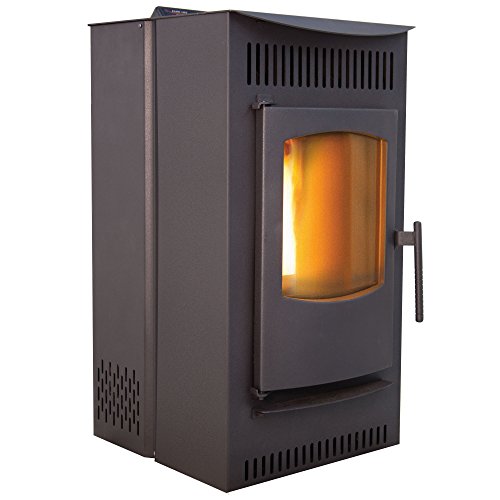
The Castle Serenity earns its place on cleaning alone. Its tubeless fire chamber has no tubes, corrugations, or hidden chambers where ash can collect, so the burn chamber is wide open and the ash pan slides straight out. Owners report that a full cleaning takes about two minutes, which is a genuine difference when you run a stove every day for a whole heating season.
Heating performance is solid for the size. The stove heats up to 1,500 square feet with a 32,000 BTU output, and its 40 lb hopper takes a full bag of pellets, giving up to 24 hours of burn time on lower settings. The Smart Controller offers four operating modes: Manual, Thermostat, Weekly, and Eco. Weekly mode lets you schedule different temperatures by day and time, while Eco mode cycles the stove on and off to hold room temperature.
There are a couple of honest drawbacks. The blower runs louder than some competitors, and the built-in thermostat tends to read high, so the room can overshoot the set temperature by a few degrees. The 40 lb hopper lasts around 18 hours on the lowest feed rate in some homes, falling short of a full day if you sleep in.
The Freedom PS21 is the pick for homes where the power goes out in winter. It pairs WiFi and touchscreen controls with a 24V battery backup system, so it keeps feeding pellets and blowing warm air during an outage instead of going cold the moment the grid drops. That backup runs on two 12V batteries, which are sold separately, so factor them into the setup. For a rural home or a cabin at the end of a long power line, this feature is worth more than a slightly larger hopper or a lower sticker figure.
Day to day, the PS21 is the most modern stove here. The touchscreen and WiFi app let you adjust temperature and feed rate from your phone, and the stove heats 800 to 1,800 square feet with a 34,700 BTU output, the widest coverage range in this guide. A 5-year warranty backs the build.
The footprint is 21 inches deep, 18 inches wide, and 37 inches tall, so it stands taller than the HP40 while keeping a narrow width. The battery backup is the headline, but remember it only helps if you buy and maintain the batteries. If your power is reliable and you never lose it in a storm, the HP40 or the Serenity gives you similar heat with less setup.
The Canyon Lodge is the quiet pick. Its Whisper Quiet Blower technology is the standout feature: the stove moves warm air without the steady blower hum that makes some pellet stoves hard to live with in a bedroom or a small living room. It also offers smart home control from a smartphone and automatic ignition. For a stove that will run all evening in the room where you relax, low noise matters more than a bigger hopper.
Coverage is up to 1,200 square feet with a 24 lb hopper, which puts it at the smaller end of this guide. That suits a single large room, a small cabin, or a well-insulated apartment rather than a whole small house. At 20.55 inches deep, 18.23 inches wide, and 32.13 inches tall, it is the lightest stove here at 149.9 lb.
The smaller hopper is the real trade-off: at 24 lb you will refill more often than with the Serenity, and the 1,200 sq ft ceiling means it is not the pick for a drafty space or a multi-room layout. This is also a less widely documented brand than ComfortBilt or Castle, so check the current listing for warranty terms and support details before ordering.
5. Cleveland Iron Works PS20W Pellet Stove
The Cleveland Iron Works PS20W is the smallest WiFi stove in this guide, built for spaces of 800 to 1,200 square feet. Its 24 lb hopper is modest, but the built-in WiFi and remote control let you adjust temperature and feed rate from your phone, which is rare at this size. At 18.23 inches wide and 32 inches tall, it fits neatly into a corner of a workshop, a home office, or a small living room, and its heat output is strong relative to that footprint.
In daily use, the stove offers two operating modes, EC01 and EC02, which let you choose between cycling on and off to hold a temperature or running continuously on low heat. The programmable thermostat avoids the overheating that happens with fixed feed-rate stoves.
There are trade-offs to weigh. The 24 lb hopper may need a mid-night refill on cold nights, and some internal components use plastic where more expensive stoves use all steel, though burn performance stays competitive. An E42 vacuum error code can appear when the unit is not cleaned regularly, so stay on top of ash removal.
Specs
Feature
Detail
Heating coverage
800 to 1,200 sq ft
Hopper capacity
24 lb
Dimensions
18.23 in W x 32 in H
Controls
WiFi, remote control, programmable thermostat
Operating modes
EC01, EC02
Ignition
Automatic
Who Should Skip It
A compact pellet stove is the wrong buy if you need to heat a large or poorly insulated home through a long winter. These stoves top out around 1,500 to 1,800 square feet in realistic conditions, and a drafty house will shrink that further. If your home is bigger than that, or you want one stove to carry the whole house, look at a larger pellet stove with a bigger hopper and higher output instead of stretching a compact model past its range.
Skip a pellet stove altogether if you cannot vent it properly. Every stove here needs a 3-inch pellet vent run to the outside, a non-combustible hearth pad, and the clearances the manual requires. Renters who cannot modify a wall, and homes without a suitable exterior wall, should consider a different heat source.
Finally, skip the smallest hoppers if you hate refilling. A 24 or 25 lb hopper is fine for evening heat, but if you want to load the stove and ignore it for a full day, choose the 40 lb Serenity or a larger model. Be honest about how much daily tending you will actually do.
FAQ
How many square feet will a compact pellet stove heat?
Most compact pellet stoves in this guide heat 800 to 1,800 square feet, depending on the model and your insulation. The HP40 Alpine and the Castle Serenity are rated to 1,500 sq ft, the Freedom PS21 covers 800 to 1,800 sq ft, and the smaller PS20W and Canyon Lodge cover 800 to 1,200 sq ft. Drafty rooms, tall ceilings, and very cold climates all reduce real coverage.
How long does a hopper of pellets last?
A 25 lb hopper usually runs through a night on a low feed setting, while a 40 lb hopper can stretch toward a full day. Actual runtime depends on the feed rate, the outside temperature, and the thermostat setting. On the lowest setting, the HP40 burns roughly 1.3 pounds of pellets per hour, and the Serenity is rated for up to 24 hours from a full 40 lb hopper.
Do pellet stoves work during a power outage?
Most electric pellet stoves stop working when the power goes out, because the auger, blower, and igniter all need electricity. The Freedom PS21 in this guide has a 24V battery backup that keeps it running during an outage, provided you have bought the two 12V batteries it needs. A gravity-feed non-electric stove is the other option for outage-prone homes, though it needs manual lighting.
What venting does a compact pellet stove need?
Compact pellet stoves vent through a 3-inch pellet vent pipe, usually run straight out through an exterior wall. Keep the vent run short and direct, with as few bends as possible, and follow the clearance and hearth pad requirements in the manual. A straight, short vent drafts better and is easier to clean.
Final Verdict
For seasonal home heating in a small space, the ComfortBilt HP40 Alpine is the best compact pellet stove overall. Its 17-inch width fits where wider stoves cannot, it heats up to 1,500 square feet, and its programmable thermostat with remote keeps the room steady without constant attention. The 25 lb hopper is the only real compromise, and it is a fair trade for the footprint.
If cleaning is what you dread, buy the Castle Serenity instead, and if your power fails in winter, the Freedom PS21 with battery backup is worth the extra setup. Measure your space, check your vent path, and pick the stove whose trade-offs you can live with all season.
Product and ASIN Reference
Product
ASIN
ComfortBilt HP40 Alpine Pellet Stove
B0CYHJYGV5
Castle Serenity 41278 Pellet Stove
B0C5NB5D95
Freedom Stove PS21 Pellet Stove
B0BYF6N9DC
Canyon Lodge Small Pellet Stove
B0D5Z8WZW4
Cleveland Iron Works PS20W Pellet Stove
B07MY6TKF8
M
Melu Editorial Team
We compare specs, materials and verified owner reviews before a product earns a spot. Rankings are never paid.
Affiliate disclosure. As an Amazon Associate we earn from qualifying purchases at no extra cost to you. Prices accurate as of the date shown.
There is no Intel i8 processor. This guide explains the mix-up and rounds up the best Intel LGA 1700 motherboards for high-end Core i7 and Core i9 builds.
Compare the best smartwatches for lg phones with Wear OS, GPS, heart rate and sleep tracking, plus battery life details to pair with your LG handset today.
Compare the best cpu coolers with push pins for Intel builds, covering tool-free mounting, socket fit, fan noise and low-profile options for simple installs.
Compare cameras for indoor guitar playing, framed for recording and streaming at home, with flip screens, microphone inputs and clean streaming output.
Four spotting scopes that pull double duty after dark, compared on aperture, magnification range and eyepiece options, with listing specs for each pick.
Four broadheads for low poundage bows compared by grain weight, blade style and cutting diameter, with every spec taken from the Amazon listing itself.
Compare four bow sights that fit Mathews risers, including Bridge-Lock dovetail sliders and a five-pin React model, by pin count, pin size and mount type.
The best ultrawide creator monitors for workstation upgrades pair color accuracy with UWQHD resolution and USB-C hubs. Compare five displays for editing.

 1. ComfortBilt HP40 Alpine Pellet Stove
 2. Castle Serenity 41278 Pellet Stove
 3. Freedom Stove PS21 Pellet Stove
 4. Canyon Lodge Small Pellet Stove