We independently review everything we recommend. When you buy through our links, we may earn a commission. As an Amazon Associate we earn from qualifying purchases.
Best Air Purifiers for Kitchen: Cutting Cooking Odors and Smoke
Compare the best air purifiers for kitchen use by activated carbon stage, smoke CADR, and manufacturer room size, with specs for cooking odors and smoke.
Compare the best air purifiers for kitchen use by activated carbon stage, smoke CADR, and manufacturer room size, with specs for cooking odors and smoke.
As an Amazon Associate, we earn from qualifying purchases made through links on this page.
A kitchen loads the air in two ways at once. Frying, searing, and toasting push out fine particles, while the smells that linger for hours afterward are mostly gases, and the two problems need two different kinds of filtration. A HEPA stage traps the particles in cooking smoke. Only an activated carbon stage adsorbs the odor molecules and the volatile compounds behind them, which is why a purifier that works well in a bedroom can disappoint next to a stove if its carbon stage is thin.
This guide therefore judges every model on the kitchen axis first: what its manufacturer documents for odor and smoke work, how much carbon the design carries, its smoke CADR figure, and the room size its maker rates it for. A purifier is a backup to ventilation, not a replacement for a vented hood, and none of the units below is built to catch grease the way a hood filter does. Placed a sensible distance from the cooktop and run during and after cooking, though, the right model clears lingering smells far faster than open windows alone. All five picks are freestanding air purifiers from established makers, sized from compact kitchen counters and corners up to open-plan kitchen and dining spaces.
What to look for
Put the carbon stage first. Cooking odor control lives or dies on activated carbon. Look for a named carbon stage in the manufacturer’s filter description: a washable or replaceable carbon filter, a high-deodorization carbon cartridge, or a combined particle and carbon filter. Carbon works by adsorption, and a heavier carbon bed generally keeps working on odors longer before it saturates. Thin carbon-coated sheets are the first thing to stop helping in a busy kitchen, so the filter design matters more here than in any other room.
Read the smoke CADR, not the headline coverage. CADR figures come in three kinds, for dust, pollen, and tobacco smoke, and the smoke number is the one that maps to cooking fumes because it tracks the finest particles. Makers often headline a room size based on one air change per hour, which flatters the unit. The AHAM suggested room size, built on the smoke CADR with roughly 4.8 air changes per hour, is the stricter and more useful figure, and it is the one quoted for each pick below where the manufacturer publishes it.
Size for the whole connected space. Many kitchens open into a dining or living area, and the purifier has to serve the combined volume, not just the cooking corner. Measure the full open area and match it against the AHAM room size. An undersized unit must run on its loudest setting to keep up during a long cooking session, while a correctly sized one can work on a middle speed and stay in the background.
Check the pre-filter and the upkeep schedule. Kitchens are dusty in their own way, with flour, spice powders, and general cooking fallout. A washable pre-filter that can be rinsed or vacuumed keeps the main filter from loading up early. Then look at replacement intervals the manufacturer states: some carbon stages need changing every few months, while combined HEPA and carbon cartridges commonly run about a year. The schedule, not the filter label, decides the real running effort.
Value auto mode and a sensor near a stove. Cooking loads arrive in bursts. A model with an air quality sensor and an automatic mode can ramp up when a pan is smoking and settle back down afterward, without anyone touching the controls with wet or greasy hands. Manual-only models work fine, but they ask you to pick a speed and remember to change it.
Keep the purifier out of the grease zone. No room purifier is a grease filter. Place the unit where air circulates through the kitchen but away from the direct plume above the cooktop, keep the intake unobstructed, and keep using the hood while cooking. The purifier’s job is the smoke and smell that escape into the room, and it does that job well when it is not being coated in cooking grease.
The Winix 5510 is the current generation of the line that replaced the long-running 5500-2, and it is built around odor work. Its four-stage path runs a washable fine mesh pre-filter, an Advanced Odor Control carbon filter that Winix rates as its high-deodorization stage, a True HEPA filter, and the switchable PlasmaWave stage. AHAM figures give it a smoke CADR of 253 CFM and a suggested room size of 392 square feet, which covers most closed kitchens and modest kitchen and dining combinations. The carbon stage is a proper separate filter rather than a coating, which is exactly what cooking smells demand.
Day to day, the 5510 suits a kitchen that cooks often. An air quality indicator changes color with the particle load, auto mode follows it, and Wi-Fi control through the Winix Smart app means the fan can be raised from another room when something on the stove gets smoky. The washable pre-filter handles the flour and dust side of kitchen air before it reaches the carbon and HEPA stages, and a filter replacement indicator takes the guesswork out of the yearly filter change.
The limits are worth noting. The AHAM room size of 392 square feet is honest but not generous, so a large open-plan space will push it to higher, louder speeds. PlasmaWave is an ion-based stage; Winix lets you turn it off, and cooks who prefer filtration only can run the unit that way. The carbon filter is part of a scheduled replacement, so odor performance depends on keeping that schedule.
The Coway Mighty has been a default large-room recommendation for years, and its filter stack explains why it earns a kitchen place. Behind a washable pre-filter sit an activated carbon filter aimed at odors and a True HEPA filter, followed by Coway’s Vital Ion stage. Coway rates the Mighty for rooms of 361 square feet on the AHAM basis, and its published CADR sits in the same class as the Winix above, so it fits a medium kitchen or a kitchen and breakfast area without strain.
Its controls fit kitchen life well. Auto mode follows the built-in air quality indicator, and Eco mode stops the fan entirely when the air has stayed clean for a period, then wakes it when particles return, which suits a room that is only loaded at mealtimes. A timer with 1, 4, and 8 hour settings lets you leave it clearing the air after dinner without running all night, and a filter indicator flags both the carbon and HEPA changes.
Two limits to weigh. This listing is the non-connected Mighty: there is no app control, and the app-enabled sibling is a separate model with a similar name, so check the exact model code before ordering. The carbon stage is a flat filter rather than a deep bed, so in a kitchen that fries daily it will want replacing on the maker’s schedule to keep odor control where it should be.
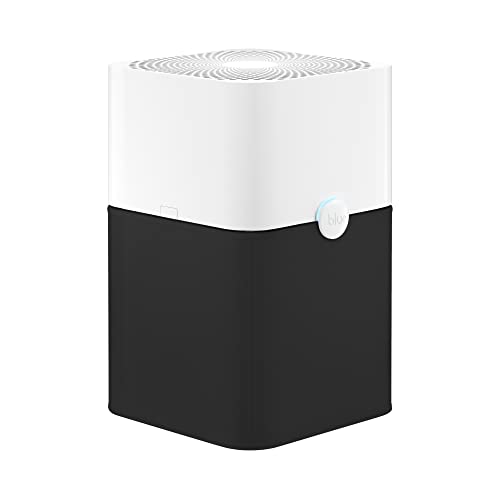
The Blue Pure 211+ is the muscle pick for open-plan homes. Blueair publishes a smoke CADR of 350 CFM and rates the unit for rooms of 540 square feet on the standard basis, the largest figures in this guide, and its HEPASilent design pairs mechanical filtration with an electrostatic stage to move that air without the bulk of a traditional box purifier. The washable fabric pre-filter wraps the outside of the unit and catches the coarse kitchen dust before it reaches the main filter, and it can be vacuumed or laundered as Blueair directs.
The main filter combines particle and activated carbon media, which handles everyday cooking smells. For homes that fry or sear heavily, Blueair also makes a SmokeBlock replacement filter with a heavier activated carbon load, and that swap is the single most kitchen-specific upgrade in this roundup: the same machine, with a carbon stage built for smoke and odor duty. The one-button control cycles through three speeds and could hardly be simpler to use with wet hands.
The trade-offs are clear in the specifications. This listing is the non-Auto 211+, so there is no air quality sensor and no automatic mode; you choose the speed yourself. The standard filter’s carbon portion is modest next to a SmokeBlock, so heavy cooks should budget the filter choice into the decision. The unit is also the largest footprint here, which matters in a small kitchen.
The Vital 200S-P is the compact, connected option, and Levoit’s own specification sheet is refreshingly precise: a CADR of 250 CFM, a rated room size of 388 square feet at 4.8 air changes per hour, noise from 23 to 54 dB, and a footprint of 15.6 by 8.5 by 19.8 inches. Filtration runs a washable pre-filter, a high-efficiency activated carbon filter, and a HEPA main filter, a three-stage layout with a genuine carbon stage for cooking odors rather than a scented accessory filter.
In a kitchen, the details add up. A real-time air quality display and auto mode let it respond to a smoking pan on its own, the VeSync app covers remote control and schedules, and the washable pre-filter is pre-installed and easy to rinse, which helps where flour and cooking dust are routine. Its slim depth tucks against a wall or at the end of a counter run where a wider unit would not fit, and sleep mode drops the noise to the bottom of its range for open-plan evenings.
Its limits follow from its size. The 388 square foot AHAM size suits a closed kitchen or a small combined space, not a big open-plan floor. The carbon media lives inside the combined replacement filter, so odor capacity is set by that cartridge and its replacement interval. It also runs from a separate power adapter, which needs a home near the unit.
The HPA304 is the current white version of Honeywell’s long-running HPA300 series, and it brings the highest AHAM numbers here after the Blueair: CADR figures of 300 for smoke, 320 for dust, and 300 for pollen, with an AHAM room size of 465 square feet. The filter arrangement is old-fashioned in a good way for kitchens. A separate activated carbon pre-filter takes the first pass at odors and larger particles, and the True HEPA R filters behind it handle the fine smoke particles.
That separate carbon pre-filter is the kitchen story. Honeywell’s guidance is to replace it roughly every three months, far more often than the yearly HEPA change, and a fresh carbon sheet is exactly what keeps cooking smells from lingering. Because the carbon stage is cheap and separate rather than built into a combined cartridge, keeping odor control at full strength is a small, routine job. Three speeds plus a turbo setting, an auto-off timer, and filter check reminders round out a deliberately simple control set.
The compromises are equally plain. There is no air quality sensor and no auto mode, so the HPA304 cannot react to a smoky pan by itself; you set the speed, and turbo is the setting that does the fast clearing after cooking. It is a filtration-only machine with no smart features at all, and its carbon pre-filter schedule is the most frequent upkeep in this guide, even if each change is quick.
Comparison table
Model
Smoke CADR
AHAM room size
Carbon stage
Washable pre-filter
Auto mode
Winix 5510
253 CFM
392 sq ft
Advanced Odor Control carbon filter
Yes
Yes
Coway Airmega Mighty AP-1512HH
233 CFM
361 sq ft
Activated carbon filter
Yes
Yes
Blueair Blue Pure 211+
350 CFM
540 sq ft
Particle and carbon filter, SmokeBlock option
Yes, fabric
No
Levoit Vital 200S-P
250 CFM
388 sq ft
High-efficiency activated carbon filter
Yes
Yes
Honeywell HPA304
300 CFM
465 sq ft
Activated carbon pre-filter
No, replaceable
No
FAQ
Can an air purifier replace a range hood in the kitchen?
No. A hood vents grease, heat, and moisture outside or through a grease filter at the source, and no room purifier is built for that load. A purifier handles the smoke particles and odor gases that escape into the room despite the hood, which is why the two work as a pair rather than as substitutes.
Why does activated carbon matter so much for cooking smells?
The lingering part of a cooking smell is mostly gas, and HEPA media cannot trap gases. Activated carbon adsorbs odor molecules and volatile compounds on its internal surface. The amount and design of the carbon stage, and how fresh it is, decide how well a purifier clears last night’s frying smell.
Where should a kitchen air purifier stand?
In the kitchen’s air path but out of the direct plume above the cooktop, with the intake and outlet unobstructed. A corner of the kitchen or the edge of the dining area in an open-plan layout works well. Keep it far enough from the stove that cooking grease does not coat the pre-filter.
How often do the filters need changing in a kitchen?
Follow each manufacturer’s schedule, and expect the carbon stage to set the pace. Separate carbon pre-filters can need changing every few months, while combined HEPA and carbon cartridges commonly run about a year. A purifier whose carbon is saturated still moves air and traps particles, but its odor control fades, so the schedule matters more in a kitchen than anywhere else.
What size purifier does an open-plan kitchen need?
Measure the whole connected area, kitchen plus dining or living space, and match it to the AHAM suggested room size rather than the headline coverage figure. If the combined space is larger than any single unit’s AHAM room size, choose the largest CADR you can place well rather than a small unit that must run at full speed to keep up.
Conclusion
For most kitchens, the Winix 5510 is the balanced pick: a documented deodorizing carbon stage, a 392 square foot AHAM room size, and sensor-driven auto running with app control. The Coway Mighty covers similar ground with a longer track record and an Eco mode that suits mealtime-only loads. Open-plan homes should look at the Blue Pure 211+ for its 350 CFM smoke CADR and the SmokeBlock filter option, while smaller kitchens get the neatest fit from the Vital 200S-P. If you would rather have raw air movement and a carbon stage you renew often and cheaply, the Honeywell HPA304 remains a sound, simple answer. Match the AHAM room size to your space, respect the carbon schedule, and any of the five will keep cooking smells from taking over the house.
A
admin
We compare specs, materials and verified owner reviews before a product earns a spot. Rankings are never paid.
Affiliate disclosure. As an Amazon Associate we earn from qualifying purchases at no extra cost to you. Prices accurate as of the date shown.
Compare five everyday backpacks for seniors: light weights, chest straps, padded backs, easy zippers, and bottle pockets for outings, errands, and travel.
Find the best doorbell cameras for Echo Spot with Alexa announcements, two-way talk, and live view on Echo Show. Compare Ring, Blink, and eufy picks now.
Compare replacement outdoor cushion covers: zippered, water-resistant shells for 20 and 24 inch seats, seat-and-back sets and a full six-seat sectional set.
Compare five electric heating pads for seniors, from a weighted 24 by 33 inch pad to a king-size model, with heat settings and auto shut-off explained.


 4. Levoit Vital 200S-P, White
 5. Honeywell HPA304