We independently review everything we recommend. When you buy through our links, we may earn a commission. As an Amazon Associate we earn from qualifying purchases.
4 Best Printers for Business Cards (November 2026)
Compare four printers for business cards, from a dry-toner color laser to borderless photo printing, with specs from each Amazon listing.
Compare four printers for business cards, from a dry-toner color laser to borderless photo printing, with specs from each Amazon listing.
The real decision when buying a printer for business cards is not print quality in general, but how the machine handles a small, heavy sheet. A business card is printed on card stock, cut from a sheet of ten, and judged by how it feels. So the paper path matters more than the resolution number: a tight, curving path jams or curls heavy stock, while a straight path or a manual feed slot lets it through flat. The second decision is whether the ink or toner is dry when the sheet lands, since a card gets cut the moment it comes out.
This guide is for freelancers and small business owners printing their own cards at home, for stallholders needing forty fresh cards before the weekend, and for designers whose card is a photograph rather than a logo. Every printer below was picked from its Amazon product page: the media it accepts, its print speed, its paper capacity, and whether it prints both sides automatically.
Quick Picks
As an Amazon Associate we earn from qualifying purchases.
Product
Best for
Key spec from title
Brother HL-L3220CDW
Runs of fifty or a hundred cards
Color laser, card stock in listed media, automatic duplex
Epson EcoTank Photo ET-8550
Cards with photographs or full-bleed color
Six-color ink, borderless printing to 13 by 19 inches
Epson EcoTank ET-2800
Occasional cards on a low ink budget
Cartridge-free ink tanks, 10 ppm black and 5 ppm color
Canon PIXMA MegaTank G3270
Cards that get handled a lot
Pigment black ink, 6,000 black and 7,700 color page yield
How to Choose
Check the Paper Path First
Card stock is thicker and stiffer than office paper, so the route it takes through the printer decides whether your cards come out flat or curled. Look for a manual feed slot or a straight-through rear path on the listing, since those feed a heavy sheet with the least bending. A printer with only a single front tray and a tight internal curve can still print a card, but expect more jams and more wasted sheets. If the listing names card stock among its supported media, that is a direct confirmation the maker tested it.
Decide Between Toner and Ink
A color laser fuses dry toner onto the sheet, so a page of ten cards can be cut the moment it lands in the tray, with no smudging where the blade passes. An ink tank printer lays down wet ink, which needs a moment to dry before cutting or stacking, but it prints photographs far better and refills from bottles rather than cartridges. If your card is mostly text and a logo, toner wins on convenience. If your card is a photograph or runs color to the edge, ink wins on looks.
Look at Duplex Printing
A business card usually has a reverse side with contact details, a map, or a short message, and printing that reverse by hand means feeding every sheet through twice. Automatic duplex printing flips the sheet inside the machine and prints the second side for you, which turns a run of a hundred cards from an evening of careful feeding into a single print job. If you plan to print double-sided cards regularly, treat automatic duplex as a requirement rather than a bonus.
Count the Running Costs Honestly
The printer is the cheap part of printing your own cards; the ink or toner and the card stock are where the money goes over time. Ink tank printers refill from bottles and print many thousands of pages from one set, while laser printers use toner cartridges that last fewer pages but never dry out between jobs. Check the rated page yield on the listing for each model, then think about how many cards you will actually print in a year. A heavy user saves with tanks, while an occasional user may prefer toner that stays ready.
The 4 Best Options
Brother HL-L3220CDW
Top Pick
Brother HL-L3220CDW
Best for: Anyone printing their own cards in runs of fifty or a hundred and cutting them the same day.
Color laser printer, print only
Print media includes card stock, envelopes, glossy photo paper, and labels
Print speed up to 19 pages per minute in black and in color
The Brother HL-L3220CDW is the leading pick for business cards because it solves the two problems that ruin home-printed cards: wet ink and manual duplexing. Its dry toner fuses onto card stock and can be cut immediately, and automatic duplex printing handles the reverse side without a second pass through the machine. A 250-sheet tray and a manual feed slot for specialty media make it practical for runs of fifty or a hundred cards, and the wireless connection lets you print from a laptop or phone.
Watch out for: No borderless printing, so a card with color to the edge must be printed oversized and trimmed.
Epson EcoTank Photo ET-8550
Runner-Up
Epson EcoTank Photo ET-8550
Best for: A photographer or designer whose card is an image rather than a logo.
Wireless wide-format color all-in-one with scanner and copier
Six-color ink set with photo black and gray, Epson 552 bottles
Borderless printing up to 13 by 19 inches
Rear feed with straight-through path for thick media
The Epson EcoTank Photo ET-8550 is the only printer here bought for photographs rather than paperwork, and it earns its place the moment your card is an image. Six-color ink with a dedicated photo black and a gray channel keeps a photographic card from looking muddy, and borderless printing up to 13 by 19 inches removes the trim-to-bleed step on a card with a colored background. A rear feed and a straight-through path handle the thickest media without curling, which is exactly what heavy card stock needs.
Watch out for: Ink is wet when it lands, so a freshly printed sheet needs a moment before cutting or stacking.
Epson EcoTank ET-2800
Epson EcoTank ET-2800
Best for: Occasional card printing where low ink costs matter more than speed.
Wireless color all-in-one with scan and copy, cartridge-free
Occasional card printing where low ink costs matter more than speed.
Watch out for
No automatic duplex, so double-sided cards need a manual second pass, and the listed media does not name card stock, so confirm heavy-stock support before buying.
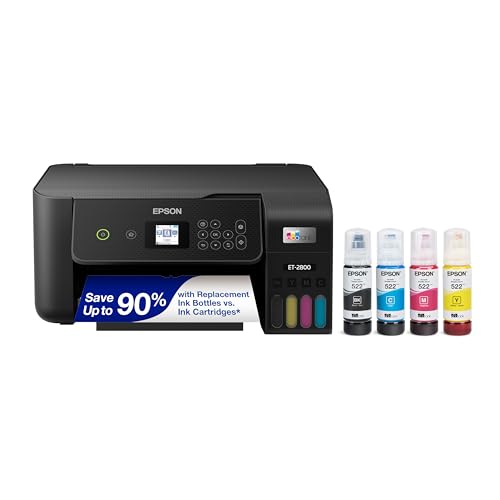
The Epson EcoTank ET-2800 is the cheapest way into genuinely low-cost color printing at home, and it suits anyone who prints cards occasionally rather than in weekly batches. Its refillable ink tanks replace cartridges entirely, and one set of bottles is rated for thousands of pages, so a small stack of cards barely dents the ink supply. The flatbed scanner and copier make it a useful all-round home printer, and wireless printing keeps it simple to use from any device in the house.
Watch out for: No automatic duplex, so double-sided cards need a manual second pass, and the listed media does not name card stock, so confirm heavy-stock support before buying.
Canon PIXMA MegaTank G3270
Canon PIXMA MegaTank G3270
Best for: Cards that will be handled often and need smudge-resistant black text.
Wireless all-in-one, print, copy, and scan
Print media includes card stock, envelopes, and glossy photo paper
The Canon PIXMA MegaTank G3270 is the pick for cards that get handled, thanks to a pigment black ink that resists smudging when fingers touch the card. Its refillable GI-21 ink bottles are rated for 6,000 black pages and 7,700 color pages from one set, and the printer lists card stock among its supported media, including a card size of 91 by 55 millimeters. Print, copy, and scan cover the usual home office jobs, and the flatbed scanner handles the occasional document without fuss.
Watch out for: No automatic duplex printing, so the reverse side of a card needs manual feeding.
Which One Fits Your Situation
You Print Cards in Regular Batches
Pick the Brother HL-L3220CDW, because dry toner and automatic duplex turn a run of a hundred cards into one print job and one cutting session. The 250-sheet tray holds enough stock for a full batch, the manual feed slot takes the heavier sheets without a jam, and the toner stays ready between jobs with nothing to dry out.
Your Card Is a Photograph
Pick the Epson EcoTank Photo ET-8550, the only printer here with six-color ink and borderless printing to 13 by 19 inches. The straight-through path keeps heavy card flat, and the photo black and gray channels keep skin tones and shadows honest on a photographic design. Just allow the ink a moment to dry before cutting the sheet.
You Print Cards Only Occasionally
Pick the Epson EcoTank ET-2800, since its bottled ink costs very little per page and the printer stays ready without cartridges drying out or running dry unnoticed. Accept the manual duplexing, because an occasional batch does not justify a faster machine, and the built-in scanner and copier cover the rest of the home office work.
Your Cards Get Handled All Day
Pick the Canon PIXMA MegaTank G3270, whose pigment black ink holds up to fingers better than dye inks. Its card stock support and the 91 by 55 millimeter card size are listed directly on the product page, and one set of bottles covers thousands of cards. The missing duplex is the trade-off, so plan on feeding the reverse side by hand.
Common Mistakes
Choosing a printer that never lists card stock as supported media, then fighting jams and curling on every sheet.
Printing a full-bleed design on a printer without borderless printing and wondering why a white edge appears.
Cutting inkjet cards the second they land and smudging the edge where the blade drags through wet ink.
Forgetting the reverse side and buying a printer without automatic duplex, then hand-feeding a hundred sheets twice.
Judging a printer by its headline resolution instead of its paper path, which is what actually decides card quality.
Frequently Asked Questions
Can I print business cards on a regular home printer?
Yes, if the printer accepts card stock and the paper path can handle a heavy sheet without curling. Look for card stock in the listed media on the product page and a manual feed slot or straight-through path. A guillotine or rotary trimmer matters as much as the printer, since ten cards to a sheet means nine cuts per sheet.
Is a laser or an inkjet printer better for business cards?
A color laser is better for text-heavy cards in batches, because dry toner can be cut immediately and automatic duplex handles the reverse. An inkjet is better when the card is a photograph or runs color to the edge, because ink prints smoother gradients and borderless models remove the white margin. Choose by the design, not by the printer type alone.
What weight of card stock can these printers handle?
It varies by model, and the product page does not always publish a maximum weight, so check the listed media and the manual feed details before buying. The Brother HL-L3220CDW and the Canon G3270 both list card stock directly, while the Epson models rely on a rear feed or straight-through path for thick media. Test one sheet before committing to a full run.
Do I need borderless printing for business cards?
Only if your design runs color to the edge of the card. Without borderless printing, the printer leaves a white margin, so you must print the design oversized on a larger sheet and trim into the color. The Epson ET-8550 is the only printer here that publishes borderless printing, which removes that extra step entirely.
M
Melu Editorial Team
We compare specs, materials and verified owner reviews before a product earns a spot. Rankings are never paid.
Affiliate disclosure. As an Amazon Associate we earn from qualifying purchases at no extra cost to you. Prices accurate as of the date shown.
Thin film batteries and fast-charging supercapacitors explained: how solid-state thin film cells work, where they are used, how they pair with capacitors, and the criteria that matter when choosing them.
The best Nikon battery replacement options compared: EN-EL15c spares from BM Premium, Wasabi Power, STK and SmallRig, with capacity, decoding and charger notes for Z and D-series cameras.
Find the best grow room thermostat for your tent or room: four plug-in temperature and humidity controllers compared by outputs, load capacity, sensor and app control.
The best battery powered fishfinders compared: castable Garmin and Deeper sonar plus the iBobber, with battery life, depth range, GPS mapping and app details to help you choose.
Compare the best 18V lithium battery packs from Milwaukee, Ryobi and Bosch by platform, amp-hours, fuel gauge and charge time, and pick the right pack for your tools.
The best animated movies on Netflix in November 2026, from KPop Demon Hunters and Steps to Klaus and Spider-Verse, with picks for family night, date night, and a quick solo watch.
Learn the best wiring for a thermostat at home: conductor counts, the standard terminal letters and colours, C-wire rules, cable ratings and a safe step-by-step wiring method.



 Canon PIXMA MegaTank G3270