We independently review everything we recommend. When you buy through our links, we may earn a commission. As an Amazon Associate we earn from qualifying purchases.
Best Grow Room Thermostat: 4 Controllers for Stable Temperature and Humidity
Find the best grow room thermostat for your tent or room: four plug-in temperature and humidity controllers compared by outputs, load capacity, sensor and app control.
Find the best grow room thermostat for your tent or room: four plug-in temperature and humidity controllers compared by outputs, load capacity, sensor and app control.
As an Amazon Associate we earn from qualifying purchases.
Affiliate Disclosure: This article contains affiliate links. If you buy through a link on this page, we may earn a commission at no extra cost to you. Product details and specifications below come from the manufacturers’ and sellers’ published product information; we have not personally tested these controllers.
Why a Grow Room Needs a Real Thermostat Controller
A grow room thermostat is not the same thing as the thermostat on your hallway wall. A wall thermostat switches a home heating and cooling system. A grow room thermostat is a plug-in controller with its own sensor probe: you plug a heater, an exhaust fan, a cooler or a humidifier into its outlets, set a target, and the controller switches that equipment on and off to hold the target automatically. That distinction matters because most indoor gardens are heated and cooled by separate, portable appliances rather than by a central system, and plants respond to the air right around the canopy, not to the temperature in the next room.
Temperature control is also only half of the job. In a sealed tent or a small room, lights add heat while plants transpire moisture, so temperature and humidity rise and fall together. A controller that can run a heater on one outlet and an exhaust fan on another — and, on some models, a humidifier or dehumidifier on a third — keeps both variables inside the band your crop stage needs. Seedlings and clones want warm, humid air. Flowering plants generally want it cooler and drier to discourage mold. A single manual routine rarely holds those conditions overnight, which is exactly when unattended rooms drift furthest.
This guide compares four plug-in controllers that suit grow tents and small grow rooms. All four are the same product type — outlet-style temperature controllers, three of them with humidity control built in — so the comparison stays honest. We looked at the number and type of controlled outlets, the maximum load each outlet can carry, sensor design and cable length, whether the unit supports Wi-Fi app monitoring, and how clearly the display shows current and target values. Check current availability on the product page before ordering, because listings and versions change.
Quick Comparison
Controller
Controls
Outlets
Connectivity
Best for
Inkbird WiFi ITC-308
Temperature (heating and cooling)
2 (heat, cool)
Wi-Fi app
Remote monitoring
Inkbird ITC-308
Temperature (heating and cooling)
2 (heat, cool)
None
Simple, proven temperature control
DIGITEN DHTC-1011
Temperature and humidity
2 (temp, humidity)
None
Combined control on a budget
SENSTREE THT103-ZJ
Temperature, humidity and timer
3 (temp, humidity, timer)
None
Mushroom and multi-device tents
1. Inkbird WiFi ITC-308 — Best for Remote Monitoring
Top Pick
1. Inkbird WiFi ITC-308 — Best for Remote Monitoring
The Inkbird WiFi ITC-308 is the Wi-Fi version of Inkbird’s long-running ITC-308 temperature controller, listed for greenhouse, breeding and grow use. It is a dual-stage unit: one outlet is assigned to heating equipment and the other to cooling equipment, so a small heater and an exhaust fan or cooler can be managed from a single probe and a single setpoint. The published maximum load is 1100W across its dual relay outputs, which covers typical tent heaters and inline fans used in home-scale rooms, though you should always confirm the draw of your own equipment against the rating printed on the listing before plugging in.
The reason to choose this version over the standard model is the app connection. The controller links to your phone over 2.4 GHz Wi-Fi, and the Inkbird app lets you check the current temperature, adjust the setpoint and receive high and low temperature alarms without opening the tent. For growers who travel, or whose room is in a garage or outbuilding, that remote check is the difference between catching a failed heater in an hour and finding stressed plants the next morning. The unit keeps working to its last settings if the connection drops, so Wi-Fi is a monitoring layer rather than a single point of failure.
On the hardware side, the ITC-308 uses a wired temperature probe you position at canopy height, a dual display that shows measured and set values together, and programmable heating and cooling differentials so equipment does not short-cycle. It also supports temperature calibration and compressor delay protection, the latter being useful if you run a small air conditioner or dehumidifier on the cooling outlet. If your room only needs temperature control — because humidity is handled by your ventilation routine — this is the most complete option here.
2. Inkbird ITC-308 — Best Simple Temperature Controller
Runner-Up
2. Inkbird ITC-308 — Best Simple Temperature Controller
The original Inkbird ITC-308 does the same core job as the Wi-Fi model without the app layer. It is a two-stage outlet thermostat: plug your heater into the heating outlet and your fan or cooler into the cooling outlet, place the sensor probe where the plants are, and set your target temperature and differentials. The published rating is 1100W at 110V, and the controller switches between heating and cooling modes automatically as conditions change, so a cold night and a hot lights-on period are both handled without you touching anything.
What you give up is remote access and alarms on your phone. What you gain is simplicity: no account, no pairing, no dependence on a router in the grow space. The front panel shows the current temperature and the set temperature side by side, and the settings are made with physical buttons, which many growers prefer in a humid room where touchscreens and apps can be awkward with wet hands or gloves. The ITC-308 has been sold for years for home brewing, incubation, reptile keeping and greenhouse work, and that long track record in adjacent uses is part of its appeal for a grow room.
This is the right pick if your grow space is at home, you walk past it daily, and humidity is managed separately — for example by a humidistat-controlled humidifier or by your extraction schedule. It is also a sensible second controller: many growers run one unit for temperature and a separate humidistat for moisture rather than asking one device to do everything, which keeps a single failure from taking down both systems at once.
3. DIGITEN DHTC-1011 — Best Combined Temperature and Humidity Control
3. DIGITEN DHTC-1011 — Best Combined Temperature and Humidity Control
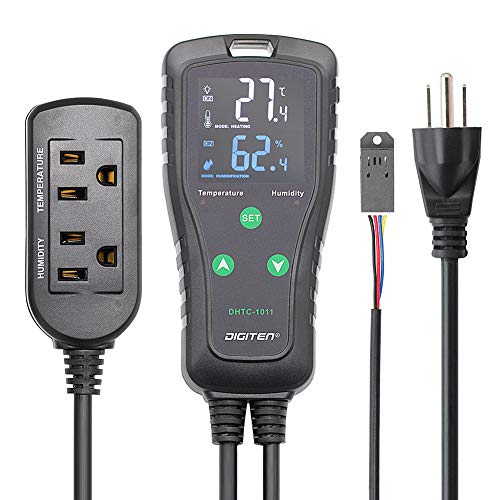
The DIGITEN DHTC-1011 is a plug-in controller that manages temperature and humidity from one combined sensor, which makes it a natural fit for a single tent where both variables matter. According to the manufacturer’s published specifications, its temperature control range runs from -40°F to 248°F and its humidity control range from 1%RH to 100%RH — far wider than any grow room needs, but that headroom means the same unit can also serve fermentation, incubation or a mushroom fruiting chamber if your hobbies expand. It has two pre-wired outlets: one handles heating or cooling equipment, the other handles a humidifier or dehumidifier, and each side is set independently.
The display is a large LCD that shows measured and set values for both temperature and humidity at the same time, so a glance tells you whether the room is inside your targets on both axes. The 2-in-1 probe keeps cable clutter down compared with running separate sensors, and the plug-and-play format means no wiring work: the controller goes between the wall socket and your appliances. For a first automated tent, that simplicity is a genuine advantage, because the most common beginner mistake is not buying the wrong controller — it is never finishing a complicated setup.
The trade-offs are the absence of Wi-Fi and a less polished app-free interface: programming is done through button combinations on the unit itself, and you will want to keep the manual nearby for the first setup. Its relays suit typical hobby equipment; check the current listing for the exact maximum load and confirm your heater’s draw before use, as with any controller in this guide. If you want one box that holds both temperature and humidity in a small room, and you do not need phone access, the DHTC-1011 is the most direct route.
4. SENSTREE Digital Temperature Humidity Controller (THT103-ZJ) — Best for Multi-Device Tents
4. SENSTREE Digital Temperature Humidity Controller (THT103-ZJ) — Best for Multi-Device Tents
The SENSTREE controller takes the combined-control idea one step further by adding a third, timer-controlled outlet. Its layout assigns outlet one to temperature (heating or cooling), outlet two to humidity (a humidifier or dehumidifier) and outlet three to a timer, which can run a light, a UV lamp or a circulation fan on a fixed schedule. For mushroom growers and tent growers who run several small appliances, that third outlet removes the need for a separate plug-in timer and keeps the whole setup on one sensor and one panel.
Temperature and humidity are read by a single 2-in-1 probe, and the three outlets work independently, so the timer schedule does not interfere with the climate relays. The manufacturer positions the unit for mushroom houses, grow tents, greenhouses and reptile enclosures, and the published product information lists the model as THT103-ZJ with a pre-wired, plug-and-play design that needs no installation work. Setup is a matter of plugging each appliance into its assigned outlet and setting the three programs.
Because it packs more functions into one housing, this controller rewards a careful first read of the instructions: each outlet has a different job, and plugging a heater into the timer outlet by mistake is an easy error in a crowded tent. Label your plugs. It also lacks Wi-Fi, so monitoring is at the panel only. In return you get the broadest device coverage of any unit here — temperature, humidity and a timed device under one controller — which suits compact tents where socket space and cable management are real constraints.
How to Choose the Right Grow Room Thermostat
Start with what you need to switch. List the appliances in your room: heater, exhaust fan, cooler, humidifier, dehumidifier, lights. A temperature-only controller like the ITC-308 covers the first three. If humidity swings are your main problem — common in sealed tents during flowering — choose a combined unit such as the DHTC-1011 or the SENSTREE so a humidifier or dehumidifier can be automated too.
Check the load rating against your heater. Controllers in this class carry published maximum loads, and space heaters are the usual problem because they draw heavily. Add up the wattage of everything on a single outlet and keep it within the rating on the product page. If your heater exceeds a plug-in controller’s rating, the safe answer is a smaller heater or professional advice, not a bigger fuse.
Place the probe at canopy height. Every controller here is only as accurate as its sensor placement. Hang the probe at the height of the plant tops, shaded from direct light and out of the direct airstream of fans and humidifiers. A probe taped to a tent wall or left near the light will hold the wrong temperature very precisely.
Decide whether you need remote alarms. Wi-Fi control, as on the WiFi ITC-308, is worth it when the room is unattended for long stretches, because an alarm on your phone can save a crop. In a room you see every day, a panel-only controller is simpler and has fewer failure modes.
Set differentials, not just targets. The gap between switch-on and switch-off points stops equipment short-cycling. A tight differential holds conditions steady but runs relays and fans more often; a wider one is gentler on equipment. Start with the manufacturer’s defaults and narrow them only if your plants or your electricity use demand it.
Frequently Asked Questions
Can I use a home wall thermostat in a grow room instead? Not directly. Wall thermostats switch low-voltage HVAC wiring, not plug-in heaters and fans, and their sensors sit outside the tent. A plug-in controller with its own probe is the correct tool for portable equipment.
Do I need humidity control as well as temperature control? In most tents, yes, eventually. Lights and transpiration push humidity up while extraction pulls it down, and high humidity in flower invites mold. If you are starting out, automate temperature first and add humidity control — either in the same unit or a separate humidistat — when you see readings drift outside your target band.
Where should the controller itself live? Outside the wettest part of the room where possible, with the probe inside. Keep the housing away from direct humidifier output and drips, and route cables so condensation cannot run down into the sockets.
What happens if the power cuts out? Controllers of this type generally resume their programmed settings when power returns, which is one reason to prefer stored digital settings over mechanical dials. Confirm the memory behavior on the product page of the model you choose if outages are common in your area.
Bottom Line
For most home grow rooms, the choice comes down to two questions: do you need the controller to run humidity equipment as well as heating and cooling, and do you want phone alerts? If temperature alone is the job and you want remote monitoring, the Inkbird WiFi ITC-308 is the strongest pick. If you want the same temperature control with no app at all, the standard ITC-308 remains a proven workhorse. If one box should hold both temperature and humidity, the DIGITEN DHTC-1011 is the straightforward option, while the SENSTREE adds a timer outlet for tents juggling several small appliances. Any of the four will hold a steadier climate than manual switching — and steadiness, more than any single feature, is what a grow room thermostat is for.
M
Melu Editorial Team
We compare specs, materials and verified owner reviews before a product earns a spot. Rankings are never paid.
Affiliate disclosure. As an Amazon Associate we earn from qualifying purchases at no extra cost to you. Prices accurate as of the date shown.
Thin film batteries and fast-charging supercapacitors explained: how solid-state thin film cells work, where they are used, how they pair with capacitors, and the criteria that matter when choosing them.
The best Nikon battery replacement options compared: EN-EL15c spares from BM Premium, Wasabi Power, STK and SmallRig, with capacity, decoding and charger notes for Z and D-series cameras.
The best battery powered fishfinders compared: castable Garmin and Deeper sonar plus the iBobber, with battery life, depth range, GPS mapping and app details to help you choose.
Compare the best 18V lithium battery packs from Milwaukee, Ryobi and Bosch by platform, amp-hours, fuel gauge and charge time, and pick the right pack for your tools.
The best animated movies on Netflix in November 2026, from KPop Demon Hunters and Steps to Klaus and Spider-Verse, with picks for family night, date night, and a quick solo watch.
Learn the best wiring for a thermostat at home: conductor counts, the standard terminal letters and colours, C-wire rules, cable ratings and a safe step-by-step wiring method.
The best battery toothbrushes for receding gums compared: soft and ultrathin bristles, sensitive modes, timers and replaceable AA or AAA power from Colgate, Philips Sonicare, quip and Oral-B.

 1. Inkbird WiFi ITC-308 — Best for Remote Monitoring
 2. Inkbird ITC-308 — Best Simple Temperature Controller
 4. SENSTREE Digital Temperature Humidity Controller (THT103-ZJ) — Best for Multi-Device Tents