Our Short List of 3

All 4 Picks at a Glance
| Product | Specs | Action |
|---|---|---|
| 1. Garmin STRIKER Cast GPS — Best for Mapping the Water You Fish | Check price on Amazon | |
 2. Garmin STRIKER Cast — Best Simple Garmin Sonar | Check price on Amazon | |
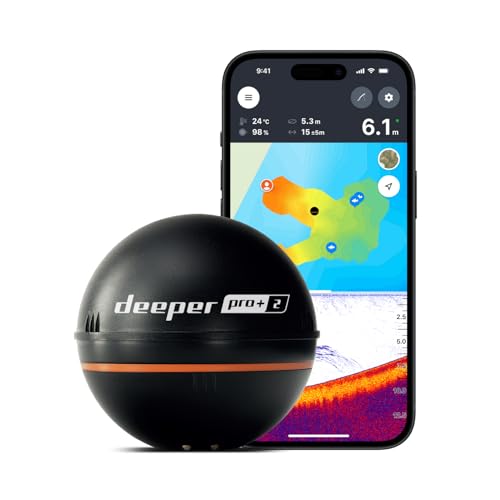 3. Deeper PRO+ 2 — Best for Long Casts and Detailed Scans | Check price on Amazon | |
 4. ReelSonar iBobber — Best Compact Bluetooth Option | Check price on Amazon |
Key takeaways
- The best battery powered fishfinders compared: castable Garmin and Deeper sonar plus the iBobber, with battery life, depth range, GPS mapping and app details to help you choose.
As an Amazon Associate we earn from qualifying purchases.
Affiliate Disclosure: This article contains affiliate links. If you buy through a link on this page, we may earn a commission at no extra cost to you. Product details and specifications are taken from the manufacturer and retailer listings, and availability can change.
A battery powered fishfinder solves a simple problem: most sonar is designed to be wired into a boat, yet a huge share of fishing happens from a bank, a dock, a kayak, a rental boat or a hole in the ice. None of those places offers a tidy 12-volt supply waiting for you. A self-contained unit carries its own rechargeable battery, turns on when you need it, and goes back in a tackle bag when you are done. There is no transducer cable to route through a hull, no fuse to fit and no battery box taking up deck space.
That freedom comes in two main shapes. Castable sonar is a small floating ball or puck that you tie to a line and throw. It sends readings wirelessly to an app on your phone, so the screen you already own becomes the display. Handheld and portable kits take the opposite approach, pairing a small dedicated screen with a transducer on a cable, which suits anglers who do not want their phone involved at all. This guide focuses on the castable, truly battery powered end of the market, because those are the units that need nothing from a boat at all. Every pick below runs on its own internal rechargeable battery, works in fresh water, and can be used from shore.
Before the individual reviews, it helps to know what actually separates these devices. Depth range tells you the deepest water the sonar can read, but the useful number for most shore anglers is how clearly it separates fish from bottom structure at the depths they really fish. Wireless range matters just as much: a castable unit is only helpful while it stays connected, and connection distance on open water is always shorter in practice than the longest figure in a listing once waves, wind and a wet hand on the phone enter the picture. Battery life is the third filter, and here the honest comparison is hours per charge against how you fish. A unit that lasts a long session and recharges over USB in the car is more useful than a slightly stronger sonar that dies before lunch.
Quick Comparison
| Product | Type | Battery life listed | Depth and range highlights | GPS mapping |
|---|---|---|---|---|
| Garmin STRIKER Cast GPS | Castable sonar | 10+ hours | Streams up to 200 ft away | Yes, Quickdraw Contours |
| Garmin STRIKER Cast | Castable sonar | 10+ hours | Streams up to 200 ft away | No |
| Deeper PRO+ 2 | Castable sonar | Rechargeable, USB cable included | Wi-Fi connection to phone app | Yes, GPS enabled |
| ReelSonar iBobber | Castable sonar | 10+ hours | Depth range of 135 ft | No built-in mapping GPS |
1. Garmin STRIKER Cast GPS — Best for Mapping the Water You Fish
The Garmin STRIKER Cast GPS, model 010-02246-02, is the pick for anglers who want more than a depth number. Alongside traditional two-dimensional sonar and an ice fishing flasher mode, it carries built-in GPS, and that GPS feeds Garmin’s Quickdraw Contours software. As you cast and retrieve, the unit records the bottom and builds custom fishing maps with contours at one-foot intervals. On an unmapped farm pond, a small reservoir or a stretch of river bank that no chart has ever covered, that turns a handful of casts into a picture of the drop-offs, channels and flats where fish hold.
The unit itself is small and light. Garmin lists it at about 2.65 ounces, with dimensions of roughly 2.99 by 2.36 by 2.99 inches, so it casts on a normal rod rather than demanding a heavy surf outfit. The internal battery is rechargeable over USB, and Garmin rates it at more than ten hours of use. There are no buttons to manage in the rain: the device powers on automatically when it floats in the water and powers off when you lift it out, which stretches that battery life across a full day without you thinking about it. The box includes the sonar, a carrying bag, a twenty-foot tether and a USB charging cable.
Sonar streams wirelessly to the free STRIKER Cast app on a compatible Apple or Android phone or tablet, from up to 200 feet away according to Garmin. Treat that figure as a best case and plan to fish it closer, which is how castable sonar is normally used anyway: cast to the structure, not to the horizon. The two-dimensional view shows fish and structure in a familiar format, and switching to the flasher mode makes the same unit useful on ice, where you lower it into a hole and watch targets in real time.
Choose this model if mapping matters to you, if you fish the same waters repeatedly and want to learn them properly, or if you want one device that covers open water and ice season. Skip it if you will never open the mapping feature, because the non-GPS version below covers the sonar basics for less commitment.
2. Garmin STRIKER Cast — Best Simple Garmin Sonar
The Garmin STRIKER Cast, model 010-02246-00, is the same castable idea without the built-in GPS. You still get traditional two-dimensional sonar and the ice fishing flasher mode, streamed wirelessly to the STRIKER Cast app on your phone or tablet from up to 200 feet away. You still get the internal USB-rechargeable battery rated at more than ten hours, the automatic power-on in water and power-off out of it, and the same compact 75-gram body with a carrying bag, tether and USB cable in the box.
What you give up is the ability to build your own contour maps. For a lot of anglers that is a fair trade. If you mainly want to answer three questions — how deep is it here, is the bottom hard or soft, and are there fish under that dock, point or weed edge — the standard STRIKER Cast answers all three without the mapping layer. It is also a sensible choice for someone buying a first castable sonar, because the workflow is as simple as this category gets: charge it, tie it on, open the app and cast.
It works in fresh water and salt water and below ice, per Garmin’s description, which makes it a flexible travel unit. Pack it for a rental boat, a pier trip or a walk along a canal and it earns its place in the bag. The honest limitation is the one shared by every phone-based sonar in this guide: your phone is the screen, so its battery, its brightness in full sun and its safety near the water all become part of the system. A waterproof phone pouch and a small power bank for the phone are worthwhile companions.
Pick the STRIKER Cast if you want Garmin’s sonar and app with the simplest brief. Pick the GPS version above if you fish home waters often enough that a self-made contour map will keep paying you back.
3. Deeper PRO+ 2 — Best for Long Casts and Detailed Scans
The Deeper PRO+ 2, model ITGAM1080, is the castable sonar to look at when range and scan detail are your priorities. It connects to your phone over its own Wi-Fi connection rather than Bluetooth, and Wi-Fi is the reason castable units of this type can hold a link at distances Bluetooth devices struggle to reach. Deeper positions the PRO+ 2 for kayaks and boats as well as shore, carp and ice fishing, and it is GPS enabled, so scans can be tied to location and used to build bathymetric maps in the Deeper app.
The package is built around travel. The listing’s included components are the PRO+ 2 sonar itself, two attachment bolts, a neoprene pouch, a quick guide and a USB wire for charging. Those attachment bolts matter more than they sound: they give you different attachment points on the ball, which changes how the sonar rides in the water when you cast it, tow it behind a kayak or lower it through ice. Using the right point keeps the transducer face oriented properly, and orientation is what keeps the reading honest.
Deeper built its reputation on scan quality for a unit this small, and the PRO+ 2 is the model in its range aimed at anglers who want the fuller feature set rather than an entry-level depth ball. In practice that means using it as a survey tool: work a grid of casts across a swim, a bay or a stretch of bank, save the scans, and study the contours and marks at home instead of guessing where the features are next time. For carp and predator anglers who fish big, featureless-looking waters, that record of what is actually down there is the entire point.
Battery power is internal and rechargeable over the included USB cable, in line with the rest of this guide: no boat wiring, no separate battery pack. As with the Garmin units, your phone supplies the display through the free app, so the same advice applies about protecting the phone and keeping it charged. Choose the PRO+ 2 if you cast far, fish from a kayak as well as the bank, or want GPS-tagged scans you can revisit. If you only fish small ponds at short range, one of the simpler units here will feel like better value for the way you actually fish.
4. ReelSonar iBobber — Best Compact Bluetooth Option
The ReelSonar iBobber takes the castable idea down to its smallest, simplest form. It is a small wireless sonar ball that pairs with iOS and Android devices over Bluetooth through its app, and it has been a familiar name in this category for years. The listing gives a depth range of 135 feet and a battery life of more than ten hours, which covers the ponds, canals, small lakes and dock edges where most shore fishing happens. It also works with a watch app, so a quick depth or fish check does not always mean pulling your phone out with wet hands.
The iBobber’s app presents fish as depth-tagged icons, distinguishing targets by size, and includes fish and strike alerts. That presentation suits casual and family fishing particularly well: instead of learning to read a raw sonar arch, you get a plain signal that something fish-shaped is sitting at a stated depth, and you can set your bait or lure to that depth. For a parent fishing with children, or an angler float fishing a new swim, that simplicity is a feature, not a compromise.
Bluetooth is both its convenience and its ceiling. Pairing is quick and the connection sips power, but Bluetooth range is shorter than the Wi-Fi link of the Deeper or the streaming range Garmin claims, so the iBobber is happiest at the modest casting distances of docks, piers, banks and ice holes rather than long-range work. It is also a sonar-only tool: there is no built-in GPS mapping, so it will not draw you a contour map of the lake.
Buy the iBobber if you want the most pocketable, least complicated way to stop guessing about depth and fish presence, especially for family trips and short sessions. Look at the Garmin or Deeper units if mapping, longer range or more detailed sonar views are part of your plan.
How to Choose a Battery Powered Fishfinder
Start with where you fish. Bank and dock anglers get the most from castable sonar, because it reaches water they cannot stand over. Kayak anglers should check attachment options and whether the unit can be towed or mounted flexibly. Ice anglers need a flasher mode or an ice setting, which the Garmin pair provides, and a battery that tolerates cold mornings, which argues for starting every trip fully charged.
Next, decide whether mapping matters. GPS in a castable sonar does not give you a chartplotter; it lets the app record where each reading came from and assemble contour maps over time. That is genuinely valuable on waters with no existing charts, and mostly decorative on a small pond you can already read at a glance. Pay for it when you fish larger home waters repeatedly.
Then think about the screen honestly. All four picks here use your phone. That keeps cost and weight down and gives you a bright, high-resolution display you already know how to use. It also means sun glare, rain, cold fingers and your phone’s own battery are part of the deal. If that trade bothers you, the alternative is a portable kit with a dedicated display and a separate rechargeable battery pack, which is bulkier but self-contained. Neither answer is wrong; they suit different anglers.
Finally, read battery claims the right way. Hours per charge are measured by each manufacturer under its own conditions, so treat them as a guide to the class of device rather than a promise. What you can control is habit: charge after every trip, store the unit part-charged rather than flat, rinse salt and grit off the charging contacts, and keep the tether or attachment point in good condition, because the most common way to lose a castable sonar is a failed knot, not a failed battery.
Care, Casting and Getting Better Readings
Technique improves castable sonar more than settings do. Cast past the feature you care about and retrieve slowly, so the unit travels over it steadily instead of bouncing across the surface. Keep the rod tip up and the line tight enough that the ball tracks straight. In wind, cast at an angle rather than directly into it, and expect the wireless link to shorten when waves repeatedly submerge the unit.
After fishing, dry the sonar before charging, check the charging contacts for corrosion, and store it in its pouch rather than loose among hooks and leads. Lithium batteries prefer moderate temperatures, so a hot car in summer is a poor storage place. A few minutes of care like this is what turns a small rechargeable device into a multi-season tool.
Frequently Asked Questions
Do battery powered fishfinders work from the bank? Yes. Castable models are designed for exactly that. You tie the sonar to a line, cast it to the spot you want to check, and read depth, structure and fish on the paired app as you retrieve it.
How deep can these units read? It depends on the model. The iBobber lists a depth range of 135 feet, which is far beyond the depth of most ponds and small lakes. Deeper and Garmin units are aimed at a broad range of fresh and salt water use; check the listing for the exact figure for the model you choose, and remember that clarity at the depths you actually fish matters more than the maximum number.
Can I use one for ice fishing? The Garmin STRIKER Cast models include an ice fishing flasher mode, and the Deeper PRO+ 2 is also positioned for ice use. Any castable sonar can be lowered into an ice hole, but a flasher display makes target watching much easier.
Will my phone battery last? The sonar has its own battery, but the app runs on your phone. Brightness is the biggest drain, so lower it when you can, close other apps, and carry a small power bank on long sessions.
Do I need a subscription? The core apps for these units are free to download and use for sonar. Some ecosystems offer optional paid layers with extra mapping or data features; the basic job of finding depth and fish does not depend on them.
Verdict
For most anglers, the Garmin STRIKER Cast GPS is the most complete battery powered fishfinder here, because it pairs long battery life and simple casting with contour mapping you cannot get from sonar alone. The standard STRIKER Cast covers the same basics for anglers who will never map. The Deeper PRO+ 2 is the choice for longer casts, kayak use and GPS-tagged scans, and the ReelSonar iBobber remains the easiest pocket-sized option for relaxed shore, dock and family fishing. Whichever you choose, you are buying information about water you used to guess at — and that, more than any single feature, is what puts more fish in front of you.